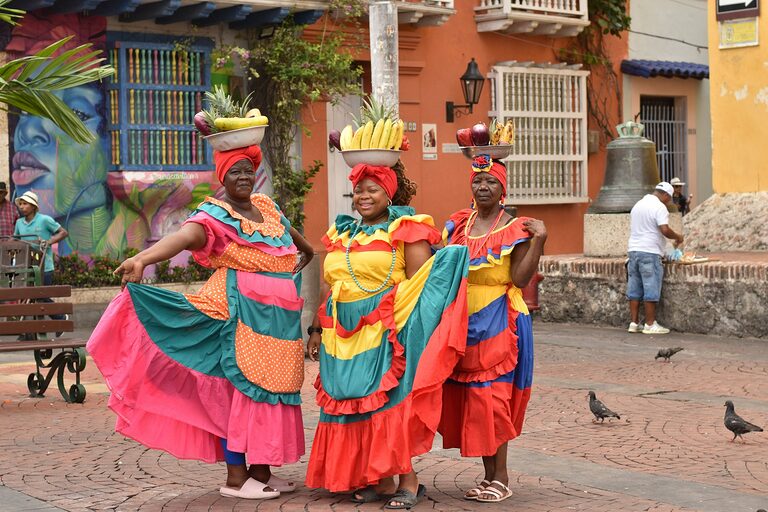
So, you are travelling to Colombia.
Excellent choice.
You have packed your passport, you have downloaded your maps.
You have researched where to find excellent Colombian coffee.
Priorities.
There is just one small matter left.
Spanish.
Spanish is the official language of Colombia and while you may encounter English speakers in hotels, hostels and popular tourist areas, knowing a few basic Spanish phrases can make travelling considerably easier.
You do not need to become fluent before your flight.
Nobody expects you to discuss Colombian history with your taxi driver after completing three lessons on a language app.
A handful of useful phrases can help you order food, ask for directions, understand prices and handle everyday situations.
And even if your pronunciation is slightly adventurous, making the effort is usually appreciated.
So, prepare your finest Spanish accent.
Here are 10 useful Spanish phrases for travellers visiting Colombia, complete with simple pronunciation guides.
1. Hola, ¿cómo estás?
👋 Meaning: Hello, how are you?
🗣️ Pronunciation: OH-lah, KOH-moh es-TAHS?
You cannot go far wrong with a friendly “hola”.
Use it when greeting hotel staff, shopkeepers, tour guides or somebody you have just met.
Adding “¿cómo estás?” turns your greeting into “How are you?”
Simple.
Friendly.
Useful.
And considerably better than silently approaching somebody while holding Google Maps towards their face.
💡 Language Tip: A simple “Hola” or “Buenos días” before asking a question is polite and makes everyday interactions feel much friendlier.
2. Por favor
🙏 Meaning: Please
🗣️ Pronunciation: por fah-VOR
Two words.
Very little effort.
Extremely useful.
“Por favor” can accompany almost any request, whether you are ordering coffee, buying a bus ticket or asking somebody for help.
You will use it constantly.
Possibly more often than the expensive phrasebook currently living untouched at the bottom of your backpack.
💡 Language Tip: Combine “por favor” with “gracias” and you already have two of the most useful Spanish expressions for polite everyday conversations.
3. Gracias
😊 Meaning: Thank you
🗣️ Pronunciation: GRAH-syahs
Another essential.
Use “gracias” after somebody helps you, serves your food, gives you directions or hands you the Colombian coffee responsible for restoring your ability to function before 9am.
You will hear it everywhere.
You should probably say it everywhere too.
💡 Language Tip: If you are particularly grateful, say “Muchas gracias”, meaning “Thank you very much”.
🗣️ Pronunciation: MOO-chahs GRAH-syahs
4. ¿Cuánto cuesta?
💰 Meaning: How much does it cost?
🗣️ Pronunciation: KWAHN-toh KWEHS-tah?
Useful at markets, useful in shops.
Useful when buying souvenirs.
Extremely useful when you have picked something up without seeing a price and are now emotionally committed to owning it.
“¿Cuánto cuesta?” allows you to ask the price of an item before reaching for your wallet.
A valuable phrase for both communication and financial survival.
💡 Language Tip: Learning Spanish numbers will make this phrase considerably more useful.
Otherwise, you may successfully ask the price and then stare blankly at the answer.
A minor flaw in the system.
5. ¿Dónde está el baño?
🚻 Meaning: Where is the bathroom?
🗣️ Pronunciation: DON-deh es-TAH el BAH-nyoh?
There are phrases you would like to know.
Then there are phrases you may suddenly need to know.
This belongs firmly in the second category.
Whether you are exploring Bogotá, wandering through Cartagena or several coffees into an enthusiastic tasting session, “¿Dónde está el baño?” may become one of the most valuable sentences in your entire vocabulary.
💡 Language Tip: The Spanish letter ñ sounds similar to the “ny” sound in “canyon”.
So “baño” sounds roughly like BAH-nyoh.
This is useful information.
Possibly urgent information.
6. Quisiera esto, por favor
🍽️ Meaning: I would like this, please.
🗣️ Pronunciation: kee-SYEH-rah EHS-toh, por fah-VOR
Restaurant menu looking slightly complicated?
Pointing remains one of international travel’s most reliable communication technologies.
“Quisiera esto, por favor” means “I would like this, please.”
Simply indicate the item you want.
Elegant?
Perhaps not.
Effective?
Absolutely.
This phrase also works when buying something in a bakery, café, shop or market.
💡 Language Tip: “Quisiera” is a polite way to say “I would like”.
Learn this word and suddenly ordering food becomes considerably easier.
Which is important.
Colombia has empanadas waiting.
7. ¿Habla inglés?
🗣️ Meaning: Do you speak English?
🗣️ Pronunciation: AH-blah een-GLEHS?
Sometimes your Spanish vocabulary reaches its limit.
You started confidently.
Hola.
Gracias.
Por favor.
Then somebody replied with an entire paragraph at impressive speed.
Time for Plan B.
“¿Habla inglés?” politely asks whether somebody speaks English.
💡 Language Tip: Do not begin every interaction by assuming the other person speaks English.
Try a little Spanish first when possible.
Even a simple greeting shows that you are making an effort.
Then, when your vocabulary dramatically collapses, you can deploy this phrase.
8. No entiendo
🤔 Meaning: I don’t understand.
🗣️ Pronunciation: noh en-TYEHN-doh
An extremely useful phrase.
Especially when somebody responds to your carefully practised Spanish with actual Spanish.
At normal speed.
Your confidence may disappear remarkably quickly.
“No entiendo” simply means “I don’t understand.”
You can combine it with a polite smile and nobody needs to know that your entire Spanish vocabulary was exhausted three sentences ago.
💡 Language Tip: You can follow this with “Más despacio, por favor”, meaning “More slowly, please.”
🗣️ Pronunciation: mahs des-PAH-syoh, por fah-VOR
This can make conversations considerably easier.
9. ¿Dónde queda…?
📍 Meaning: Where is…?
🗣️ Pronunciation: DON-deh KEH-dah…?
This phrase is extremely useful when asking for directions.
Simply add the place you are trying to find.
¿Dónde queda el hotel?
Where is the hotel?
¿Dónde queda la estación?
Where is the station?
¿Dónde queda la playa?
Where is the beach?
You get the idea.
💡 Language Tip: Save important destination names and addresses on your phone.
If pronunciation becomes difficult, you can show somebody the written address while asking “¿Dónde queda?”
Technology and Spanish working together.
Beautiful.
10. La cuenta, por favor
🧾 Meaning: The bill, please.
🗣️ Pronunciation: lah KWEHN-tah, por fah-VOR
You have eaten the arepas, you have finished the bandeja paisa.
You ordered dessert despite confidently announcing 20 minutes earlier that you were completely full.
Now you need the bill.
“La cuenta, por favor” is the phrase to remember.
It is short, polite and useful in restaurants and cafés throughout Colombia.
💡 Language Tip: In many restaurants, you may need to ask for the bill rather than expecting it to arrive immediately.
Learn this phrase and you can confidently complete your meal.
Until somebody suggests another coffee.
Then apparently you are staying.
✨ Final Colombia Language Thoughts
You do not need perfect Spanish to travel around Colombia.
You do not even need particularly impressive Spanish.
A few useful phrases can make an enormous difference.
Learn how to say hello.
Say please.
Say thank you.
Know how to ask where the bathroom is.
That one deserves priority.
Download Spanish for offline use in your translation app and save important addresses on your phone.
Most importantly, do not be afraid to try.
You may pronounce something incorrectly, you may forget a word.
You may accidentally create a sentence that makes absolutely no grammatical sense.
It happens.
Smile.
Try again.
Point if necessary.
Travellers have been communicating this way successfully for centuries.
And after several days in Colombia, you may be surprised by how quickly certain phrases become automatic.
“Hola.”
“Gracias.”
“Por favor.”
“La cuenta, por favor.”
And perhaps the most important phrase you will need after discovering just how good Colombian coffee can be:
Otro café, por favor.
🗣️ Pronunciation: OH-troh kah-FEH, por fah-VOR
Meaning: Another coffee, please.
Some phrases are simply too important to leave off the list.
Frequently Asked Questions
Useful phrases include greetings, asking for directions, ordering food, asking about prices and saying thank you. Learning these basic expressions can make everyday interactions easier.
No, but knowing some basic Spanish can be very helpful, especially when travelling outside major tourist areas where English may be less widely spoken.
Practise common travel phrases, listen to Spanish regularly and try using simple expressions when ordering food, shopping or asking for directions.
Discover more Colombia travel tips:
- Following these top travel hacks for Colombia can help you communicate more confidently while navigating transport, accommodation and everyday travel.
- Knowing the top things you shouldn’t do as a tourist in Colombia can help you avoid misunderstandings and show greater respect for local customs.
- Trying top adventure activities in Medellín can give you opportunities to practise simple Spanish while enjoying outdoor experiences and meeting local people.