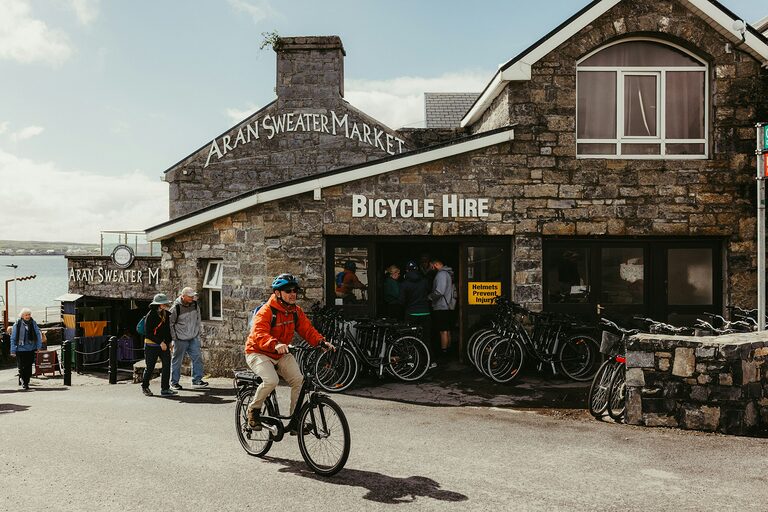
So, you are travelling to Ireland.
Excellent choice.
You have packed your waterproof jacket.
Downloaded your offline maps.
Prepared yourself for beautiful green landscapes, dramatic cliffs, ancient castles and weather that changes its mind approximately every 15 minutes.
But there is one more thing worth packing.
A few Irish phrases.
Now, you might be thinking:
“Don’t they speak English in Ireland?”
Yes.
English is the most widely spoken language throughout Ireland.
But Ireland also has its own beautiful native language.
Irish.
Or Gaeilge, as it is known locally.
You will see Irish on road signs, public buildings and place names throughout the Republic of Ireland.
In certain regions, known as the Gaeltacht, Irish remains an important part of everyday conversation.
And while you certainly do not need to speak Irish to enjoy your holiday, learning a few expressions can make your experience even more memorable.
There is just one small complication.
Irish pronunciation.
You may look at a word.
Recognise several letters.
Feel reasonably confident.
Then hear somebody pronounce it and wonder whether you have accidentally been studying an entirely different language.
Do not worry.
Irish spelling follows its own rules, and pronunciation varies between regional dialects.
To help you get started, here are 10 useful Irish phrases for travellers, complete with simple pronunciation guides.
The pronunciations below are approximate English-friendly guides. Actual sounds can vary between Irish dialects.
1. Dia Duit: Hello
Pronunciation: DEE-uh gwit
👋 Every great adventure begins with a greeting.
And in Ireland, one traditional way to say hello is Dia duit.
Literally, the expression means “God be with you”.
Which is considerably more elaborate than simply saying “Hi”.
But Ireland has never been a country afraid of giving a greeting a little personality.
You may hear this phrase in Irish-speaking communities or when people are deliberately speaking Irish.
In everyday English conversations, a simple “Hello” or “Hi” is far more common.
💡 Travel Hack: Try using Dia duit when visiting a Gaeltacht area or speaking with somebody who uses Irish.
A traditional response is Dia is Muire duit, meaning “God and Mary be with you”.
Do not worry if you cannot remember the longer response immediately.
Start with hello.
Master the complicated greetings later.
You are on holiday.
Not sitting an advanced Irish language examination.
2. Go Raibh Maith Agat: Thank You
Pronunciation: guh rev mah AG-ut
🙏 Good manners are useful everywhere.
Especially when travelling.
Somebody gives you directions.
A café serves an excellent breakfast.
A local recommends a beautiful coastal walk that was not in your guidebook.
Or a kind stranger explains which bus you actually need after you have confidently been waiting on the wrong side of the road.
These are excellent opportunities to say thank you.
In Irish, that is Go raibh maith agat.
It may look complicated.
But once you become familiar with the sounds, it becomes much easier.
💡 Travel Hack: Practise this phrase a few times before travelling.
Use it when speaking Irish with locals, particularly in Irish-speaking areas.
And remember that a genuine smile is an excellent addition to any thank you.
Even if your pronunciation sounds slightly experimental.
The effort is what matters.
Your Irish teacher, should you ever acquire one, can worry about the finer details later.
3. Le Do Thoil: Please
Pronunciation: leh duh hull
😊 Please.
A small word.
A useful word.
A word that becomes particularly important when you are asking somebody for assistance.
Le do thoil is a common way of saying “please” in Irish when addressing one person.
You might use it when requesting help, asking for something or practising a simple Irish sentence.
Of course, most everyday interactions in Ireland will happen in English.
But knowing the Irish equivalent is a nice addition to your vocabulary.
💡 Travel Hack: Learn this phrase alongside Go raibh maith agat.
Please and thank you make a useful combination.
They are also considerably easier to remember than an elaborate sentence explaining why you accidentally ordered three breakfasts.
Although that situation may require more than language skills.
It may require an exceptionally large appetite.
4. Gabh Mo Leithscéal: Excuse Me
Pronunciation: gov muh LESH-kayl
🙋 Travelling involves asking questions.
Lots of questions.
Where is the station?
Is this the correct bus?
Does this road lead to the castle?
Is that pub still serving food?
And, occasionally:
“Excuse me, is that sheep supposed to be standing in the middle of the road?”
In Irish, Gabh mo leithscéal means “Excuse me”.
It can also be used when apologising or politely attracting somebody’s attention.
A particularly useful expression when exploring unfamiliar places.
💡 Travel Hack: Use this phrase as a polite way to begin a question when speaking Irish.
If the conversation continues in English, that is perfectly fine.
You have still made an effort.
And if you are asking for directions, remember that Irish people can be wonderfully conversational.
You may receive detailed instructions.
Several alternative routes.
A recommendation for a nearby café.
And an interesting story about somebody who once lived near the road you are looking for.
All you wanted was the bus station.
You may leave with a complete local history lesson.
Consider it a bonus attraction.
5. Cá Bhfuil An Leithreas?: Where Is The Toilet?
Pronunciation: kaw wil un LEH-thras
🚻 Some travel phrases are useful.
Others are essential.
This one belongs firmly in the second category.
Cá bhfuil an leithreas? means “Where is the toilet?”
A question that becomes increasingly important after a long journey, several cups of tea or an enthusiastic visit to a traditional Irish pub.
You may never need to use this phrase.
But it is reassuring to know it.
Especially when travelling through smaller towns or rural areas.
💡 Travel Hack: Save this phrase on your phone along with other useful travel expressions.
Public toilets are available in many towns and attractions, but facilities can be limited in rural locations.
Take advantage of toilets at cafés, visitor centres and petrol stations when available.
Do not assume another one will appear conveniently around the next corner.
Particularly if the next corner is followed by 30 kilometres of countryside.
Beautiful countryside.
But countryside nonetheless.
6. Cé Mhéad Atá Air?: How Much Is It?
Pronunciation: kay vay-ud uh-TAW er
💶 Ireland has plenty of opportunities to spend money.
Souvenirs.
Traditional crafts.
Woollen jumpers.
Local food.
Handmade jewellery.
And approximately seventeen different objects featuring shamrocks.
You may arrive intending to buy one small souvenir.
Then discover a beautifully made Aran jumper.
Suddenly, your budget is facing an unexpected challenge.
Cé mhéad atá air? means “How much is it?”
It is a useful phrase when asking the price of a particular item.
💡 Travel Hack: Learn this phrase if you plan to visit markets or shops in Irish-speaking areas.
Remember that prices in the Republic of Ireland are displayed in euros, while Northern Ireland uses pounds sterling.
If somebody answers in Irish and you do not understand the amount, do not panic.
You can politely ask them to repeat it or show you the price.
There is no shame in checking.
Especially when your carefully selected souvenir turns out to cost considerably more than expected.
That jumper may be beautiful.
But your bank account deserves a say in the decision.
7. Sláinte: Cheers!
Pronunciation: SLAWN-chuh
🍻 Now we are getting to the important cultural education.
Sláinte means “health” and is commonly used as a toast.
It is one of the most recognisable Irish expressions.
And probably one of the easiest to remember.
You might hear it in pubs, at celebrations or when people raise their glasses together.
It works whether you are enjoying a pint of Guinness, a glass of cider or a non-alcoholic drink.
The important part is the shared moment.
Not what is inside the glass.
💡 Travel Hack: When somebody raises a glass and says Sláinte, you can respond with the same word.
Simple.
Friendly.
And considerably easier than attempting a five-minute speech about the importance of friendship.
You can practise it before travelling.
Although practising does not require drinking anything.
A glass of water will do perfectly well.
Your liver appreciates cultural education that involves moderation.
8. Conas Atá Tú?: How Are You?
Pronunciation: KUN-us uh-TAW too
💬 Irish people are often happy to engage in conversation.
And sometimes, a simple greeting can turn into a surprisingly enjoyable discussion.
Conas atá tú? means “How are you?”
It is an informal way to ask one person how they are doing.
You might hear other forms depending on the region.
And, of course, in everyday English conversations, you may encounter the wonderfully Irish greeting:
“What’s the craic?”
Which is not nearly as alarming as it might sound to somebody unfamiliar with Irish slang.
Craic refers to fun, news, conversation or general enjoyment.
So when somebody asks about the craic, they are not asking you to participate in anything suspicious.
Usually.
💡 Travel Hack: Practise Conas atá tú? and learn one simple response.
Tá mé go maith means “I am well”.
You can also enjoy learning common Irish English expressions.
For example, “grand” often means fine or satisfactory.
And “What’s the craic?” is a friendly way of asking what is happening.
Irish conversation has plenty of personality.
Sometimes the language lesson begins before you have even ordered your coffee.
9. Ní Thuigim: I Don’t Understand
Pronunciation: nee HIG-im
🤔 Every traveller eventually experiences a moment of linguistic confusion.
Somebody says something.
You smile.
They continue.
You smile again.
They ask a question.
You realise that you have understood approximately none of the conversation.
Congratulations.
You have entered the international travel experience.
Ní thuigim means “I don’t understand”.
A wonderfully practical expression when somebody speaks Irish faster than you can follow.
Which, as a beginner, may happen almost immediately.
Irish has sounds and grammatical patterns that can be unfamiliar to English speakers.
And regional accents add another layer of variety.
💡 Travel Hack: Do not pretend to understand something important.
If you are confused, politely ask for clarification.
You can say Ní thuigim and then ask whether the person speaks English.
Most people in Ireland do.
And remember that language mistakes are a normal part of travelling.
You might mispronounce something.
Forget a word.
Or accidentally produce a sentence that sounds nothing like the one you intended.
Smile.
Try again.
At least you are making an effort.
That is considerably better than confidently nodding and accidentally agreeing to something you do not understand.
10. Slán: Goodbye
Pronunciation: slawn
👋 Every journey eventually involves saying goodbye.
To a wonderful city.
A beautiful village.
A friendly local.
A cosy pub.
Or a café that served a breakfast so good you briefly considered rearranging your entire itinerary.
Slán is a common Irish expression for goodbye.
It is short.
Simple.
And easy to remember.
You may also hear Slán go fóill, meaning “Goodbye for now”.
Which feels particularly appropriate when leaving Ireland.
Because there is a reasonable chance you will already be thinking about coming back.
💡 Travel Hack: Use Slán when leaving an Irish-language conversation.
It is a friendly way to finish your interaction.
And if you want to sound a little more optimistic about returning, try Slán go fóill.
After all, goodbye does not necessarily mean forever.
Especially when you have only explored a small part of Ireland.
There are still castles to visit.
Coastal roads to drive.
Villages to discover.
And several hundred photographs of green hills you have not yet taken.
Your next trip is practically planning itself.
✨ Final Irish Language Thoughts
Ireland is a country with a rich history, a distinctive culture and a language that has survived centuries of change.
And while English will take you almost everywhere as a traveller, learning a little Irish adds another dimension to your experience.
You begin noticing the language on road signs, you recognise words on buildings.
You understand why certain places have names that look nothing like their English equivalents.
And occasionally, you might even recognise something somebody says.
Which is a surprisingly satisfying feeling.
You do not need to become fluent.
You do not need to memorise complicated grammar.
And you certainly do not need to master every regional pronunciation before boarding your flight.
Start small.
Learn hello, learn thank you, learn please.
Learn cheers.
And definitely learn how to ask where the toilet is.
Priorities matter.
Use your new phrases when appropriate.
Listen to how local speakers pronounce them.
Ask questions.
Do not worry about making mistakes.
You may discover that somebody is delighted you are interested in the language.
They might teach you another expression.
Explain the meaning of a place name.
Or tell you something interesting about Irish culture.
And before you know it, a simple conversation has become one of your favourite travel memories.
That is the wonderful thing about learning a little of the local language.
It turns ordinary moments into opportunities to connect.
So, pack your waterproof jacket.
Charge your phone.
Bring comfortable shoes.
Prepare for the rain.
Practise your Irish.
And when you find yourself in a cosy pub, listening to traditional music after a day exploring the beautiful Irish countryside, raise your glass and say:
Sláinte!
You have officially added a little Irish to your adventure.
And when the time comes to leave?
Slán go fóill.
Goodbye for now.
Because Ireland has a habit of making visitors want to return.
And next time, perhaps you will know eleven phrases.
Ambitious.
But entirely achievable.