So, you are travelling to Brazil.
Excellent choice.
You have packed your clothes, checked your passport and probably spent considerably too much time imagining yourself sitting on a Brazilian beach with something cold to drink.
There is just one small thing left.
Portuguese.
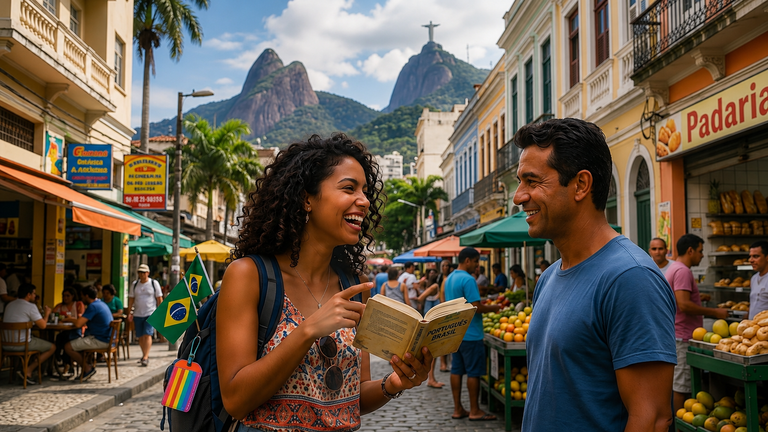
Brazil’s official language is Portuguese and although you may find English speakers in hotels and popular tourist areas, knowing a few local phrases can make travelling considerably easier.
And no, speaking Spanish slowly while adding dramatic hand gestures does not magically turn it into Portuguese.
Nice attempt, though.
You do not need to become fluent before your flight.
A handful of useful phrases can help you order food, ask for directions, deal with transport and generally avoid standing somewhere looking confused while hoping somebody understands your eyebrows.
To help you communicate with confidence, here are 10 useful Portuguese phrases every traveller should know when visiting Brazil.
1. Olá
👋 Meaning: Hello
🔊 Pronunciation: oh-LAH
Simple.
Friendly.
Useful approximately 47 times per day.
“Olá” is one of the easiest ways to greet someone in Brazil and works in plenty of everyday situations.
You may also hear “Oi”, an informal and extremely common way of saying “Hi”.
💡 Travel Tip: A friendly greeting before asking a question or ordering something is always a good habit.
Start with “Olá” and you are already doing better than walking directly up to somebody and announcing “TOILET?”
2. Bom dia
☀️ Meaning: Good morning
🔊 Pronunciation: bohng JEE-ah
“Bom dia” is a polite greeting used during the morning.
You will hear it in hotels, cafés, shops and plenty of other everyday situations.
It is simple, friendly and immediately makes you sound slightly more prepared.
Even if you have only been awake for seven minutes.
💡 Travel Tip: You can also use “Boa tarde” for “Good afternoon” and “Boa noite” for “Good evening” or “Good night”.
A few greetings can take you surprisingly far.
3. Por favor
🙏 Meaning: Please
🔊 Pronunciation: por fah-VOR
Possibly one of the most important phrases in any language.
Whether you are ordering coffee, buying a ticket or asking somebody for help, “por favor” makes everything sound considerably more polite.
Nobody has ever suffered from having too many manners in their suitcase.
💡 Travel Tip: Add “por favor” when ordering food, requesting something or asking for assistance.
Even if the rest of your Portuguese consists mainly of pointing at things, at least you will be pointing politely.
4. Obrigado / Obrigada
😊 Meaning: Thank you
🔊 Pronunciation: oh-bree-GAH-doo / oh-bree-GAH-dah
This is one phrase you will probably use constantly.
Men traditionally say “Obrigado”.
Women traditionally say “Obrigada”.
Either way, it means “Thank you”.
And you will have plenty of opportunities to use it.
Hotel staff.
Waiters.
Taxi drivers.
The person who just handed you pão de queijo.
Especially that person.
💡 Travel Tip: Learn this phrase before you arrive.
Showing appreciation in the local language is one of the easiest ways to create positive interactions while travelling.
5. Você fala inglês?
🗣️ Meaning: Do you speak English?
🔊 Pronunciation: voh-SEH FAH-lah een-GLEYS?
Sometimes your Portuguese reaches its limit.
Possibly around phrase number four.
That is perfectly fine.
“Você fala inglês?” is an extremely useful question when you need more detailed information than your Portuguese vocabulary can currently handle.
💡 Travel Tip: Do not assume somebody speaks English.
Ask politely first.
If the answer is no, translation apps, gestures and creative pointing can form an unexpectedly effective international communication system.
6. Quanto custa?
💰 Meaning: How much does it cost?
🔊 Pronunciation: KWAN-too KOOS-tah?
Shopping.
Markets.
Souvenirs.
Snacks.
That colourful item you absolutely do not need but have already emotionally committed to buying.
“Quanto custa?” is extremely useful whenever you need to ask the price of something.
💡 Travel Tip: Learning basic Portuguese numbers can also be useful when shopping.
Alternatively, asking the seller to show you the price on a calculator or phone can avoid confusion.
International mathematics rarely requires translation.
7. Onde fica…?
📍 Meaning: Where is…?
🔊 Pronunciation: ON-jee FEE-kah…?
Eventually, every traveller gets lost.
Sometimes accidentally.
Sometimes because Google Maps has confidently suggested walking through what appears to be somebody’s garden.
“Onde fica…?” allows you to ask where something is located.
For example:
Onde fica o banheiro?
Where is the bathroom?
An extremely important sentence.
Possibly the most important sentence in this entire article under certain circumstances.
💡 Travel Tip: Save the names of your hotel, attractions and transport stations on your phone.
You can say “Onde fica…?” and show the location name if pronunciation becomes difficult.
8. Eu gostaria de…
🍽️ Meaning: I would like…
🔊 Pronunciation: eh-OO gohs-tah-REE-ah jee…
This phrase is particularly useful in restaurants and cafés.
“Eu gostaria de…” allows you to politely say what you would like.
Coffee.
Water.
Dinner.
Another caipirinha.
Potentially another caipirinha.
Brazil is a holiday, after all.
💡 Travel Tip: Keep a translation app handy when reading menus.
Brazilian cuisine varies enormously between regions, so you are likely to encounter plenty of unfamiliar dishes.
Try them.
Within reason.
9. A conta, por favor
🧾 Meaning: The bill, please
🔊 Pronunciation: ah KON-tah por fah-VOR
You have eaten everything.
You have considered dessert.
You ordered dessert.
You have now reached the stage where moving from your chair feels like an ambitious physical challenge.
Time for the bill.
“A conta, por favor” is the phrase you need.
💡 Travel Tip: In restaurants, you may need to ask for the bill rather than expecting it to arrive immediately.
Use this phrase and you will be ready to pay.
Whether you are ready to stand up after that enormous Brazilian meal is another matter entirely.
10. Socorro!
🆘 Meaning: Help!
🔊 Pronunciation: soh-KOH-hoo!
Hopefully, you will never need this one.
But knowing how to call for help in the local language is always sensible when travelling.
“Socorro!” is used when you urgently need help.
For less urgent situations, you can use:
Pode me ajudar?
🔊 Pronunciation: POH-jee mee ah-zhoo-DAR?
This means:
Can you help me?
Much calmer.
Much better suited to situations involving confusing ticket machines rather than actual emergencies.
💡 Travel Tip: Save important emergency information on your phone before travelling, including details for your accommodation, travel insurance and relevant local emergency services.
Hopefully, the most serious crisis you encounter will involve forgetting where you left your sunglasses.
✨ Final Brazil Language Thoughts
You do not need perfect Portuguese to enjoy Brazil.
You do not even need particularly good Portuguese.
A few useful phrases, a friendly attitude and a willingness to occasionally sound slightly ridiculous can take you surprisingly far.
Say “Olá”.
Use “Por favor”.
Remember “Obrigado” or “Obrigada”.
Ask “Quanto custa?” before buying that suspiciously expensive souvenir.
And keep “Onde fica o banheiro?” safely stored somewhere in your memory.
You never know when greatness will be required.
Most importantly, do not worry about making mistakes.
Speaking another language while travelling is not an exam.
Nobody is waiting behind a nearby palm tree with a clipboard marking your pronunciation.
Make the effort.
Listen to how locals speak.
Smile when you get something wrong.
Use your translation app when necessary.
And gradually, Portuguese words that initially sounded completely unfamiliar may begin to make sense.
By the end of your Brazilian adventure, you may still be far from fluent.
But you will hopefully be able to say hello, order dinner, find the bathroom and ask for the bill.
Which, when you think about it, covers a surprisingly large percentage of travelling.
Frequently Asked Questions
Useful phrases include basic greetings, asking for directions, ordering food, requesting assistance and polite expressions in Portuguese.
English is more commonly spoken in major tourist areas and hotels, but learning a few Portuguese phrases can make everyday communication much easier.
No, you can travel around Brazil without speaking Portuguese, but knowing a few basic phrases can help you communicate with locals and navigate everyday situations more confidently.
Discover more Brazil travel tips:
- Using these essential Brazil travel hacks can help you navigate transport, manage everyday expenses and enjoy a smoother trip.
- Following these top things you shouldn’t do as a tourist in Brazil can help you respect local customs and avoid common travel mistakes.
- Discovering top adventure activities in São Paulo is a great way to enjoy hiking, cycling, outdoor parks, nature escapes and other active experiences around the city.