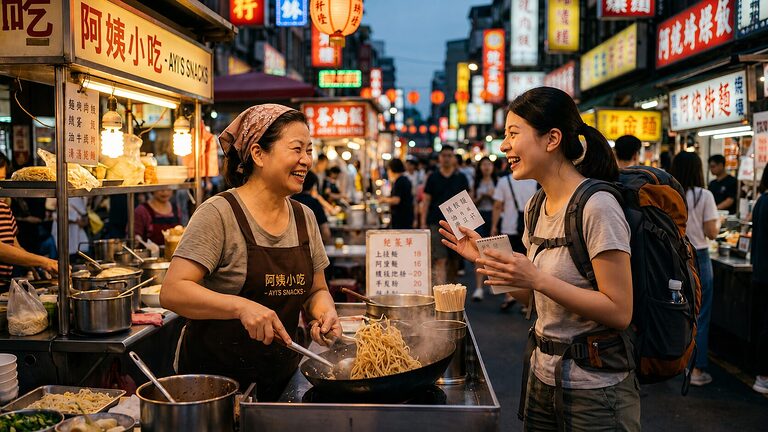
So, you are travelling to Taiwan.
Excellent choice.
Your bags are packed.
Your itinerary is ready.
And you have probably already made a suspiciously long list of foods you intend to eat.
There is just one small thing left.
Learning a little Mandarin.
Do not panic.
Nobody expects you to become fluent before your flight lands.
Mandarin Chinese is widely spoken in Taiwan and learning just a handful of useful phrases can make travelling much easier.
It can help you order food, ask for directions, find a toilet and occasionally rescue yourself from situations where pointing enthusiastically is simply not enough.
Even better, making an effort to speak a little Mandarin is often appreciated by locals.
Your pronunciation may not be perfect.
That is fine.
Confidence, a friendly smile and a translation app can handle the rest.
Here are 10 useful Mandarin phrases every traveller should know when visiting Taiwan.
1. Nǐ Hǎo | Hello
👋 Pronunciation: Nee how
This is the classic phrase every traveller should know.
It means “hello” and is a simple, friendly way to greet someone.
You can use it when entering a small shop, speaking to hotel staff or asking someone for help.
💡 Travel Tip: Mandarin is a tonal language, so pronunciation matters. Do not worry about sounding perfect, though.
A friendly attempt and a smile can go a long way.
2. Xièxie | Thank You
🙏 Pronunciation: Shyeh-shyeh
You will probably use this phrase more than almost any other.
Use it when someone helps you, serves your food, gives you directions or patiently explains something while you stare at them with the expression of someone who understands absolutely nothing.
💡 Travel Tip: Learn this phrase before anything complicated.
A sincere “xièxie” combined with a smile works wonderfully in everyday interactions.
3. Bù Hǎo Yìsi | Excuse Me / Sorry
🙇 Pronunciation: Boo how ee-suh
This incredibly useful phrase can mean something similar to “excuse me”, “sorry” or “pardon me”, depending on the situation.
Need to squeeze past someone?
Bù hǎo yìsi.
Accidentally bump into somebody?
Bù hǎo yìsi.
Need to politely get someone’s attention?
You guessed it.
💡 Travel Tip: This is one of the most useful phrases to remember when travelling around busy cities, markets and public transport.
You may end up using it several times before breakfast.
4. Zhège Duōshǎo Qián? | How Much Is This?
💰 Pronunciation: Juh-guh dwor-shaow chyen?
Shopping in Taiwan can be dangerous.
Not physically dangerous.
Financially dangerous.
Especially when you discover markets filled with souvenirs, snacks, clothes and mysterious little things you suddenly decide you absolutely need.
This phrase means “How much is this?”
💡 Travel Tip: Point at the item while asking the question.
If you do not understand the spoken answer, politely ask the seller to show you the price on a calculator or your phone.
Technology saves the day once again.
5. Xǐshǒujiān Zài Nǎlǐ? | Where Is The Toilet?
🚻 Pronunciation: Shee-show-jyen dzai nah-lee?
Forget sophisticated conversation.
This may be the most important phrase on the entire list.
It means “Where is the toilet?”
Learn it.
Remember it.
Treasure it.
Your future self may be extremely grateful.
💡 Travel Tip: Save this phrase on your phone as well as learning how to say it.
If pronunciation fails you at the crucial moment, technology can come to the rescue.
6. Wǒ Yào Zhège | I Would Like This
👉 Pronunciation: Waw yaow juh-guh
This means “I want this” or, more naturally in a travel situation, “I would like this.”
It is incredibly useful when ordering food or buying something.
Simply point.
Say the phrase.
Smile confidently.
Congratulations.
You are communicating.
💡 Travel Tip: This phrase is particularly helpful at night markets where menus may not always have English translations.
Pointing is not cheating.
It is an internationally recognised travel skill.
7. Zhège Huì Là Ma? | Is This Spicy?
🌶️ Pronunciation: Juh-guh hway lah mah?
This means “Is this spicy?”
An important question.
Especially if your personal definition of “slightly spicy” means noticing that somebody once stored a chilli somewhere in the same kitchen.
Taiwanese food ranges from mild and comforting to dishes with considerably more kick.
💡 Travel Tip: If you do not want spicy food, you can say Bú Yào Là, pronounced “Boo yaow lah”, meaning “I don’t want it spicy.”
Your taste buds may thank you.
8. Zài Nǎlǐ? | Where Is…?
📍 Pronunciation: Dzai nah-lee?
This simple phrase means “Where is…?”
It becomes extremely useful when combined with the name of a place.
Show someone the destination on your phone, then ask:
“Zài nǎlǐ?”
This can help you find railway stations, attractions, hotels and the restaurant you have somehow walked past three times already.
💡 Travel Tip: Save important destinations on your phone so you can show someone exactly where you are trying to go.
This can make asking for directions considerably easier.
9. Nǐ Huì Shuō Yīngwén Ma? | Do You Speak English?
🗣️ Pronunciation: Nee hway shwor ying-wun mah?
This means “Do you speak English?”
A very useful question when your Mandarin vocabulary has officially reached its limit.
In popular tourist areas, hotels and major cities, you may meet people who speak some English.
But never assume.
Ask politely.
💡 Travel Tip: If the answer is no, do not panic.
Translation apps, maps, photographs and pointing can solve an impressive number of communication problems.
You have technology.
You will probably be fine.
10. Hǎochī! | Delicious!
😋 Pronunciation: How-chur
This means “delicious!”
And in Taiwan, you may find yourself saying it rather frequently.
Beef noodle soup?
Hǎochī.
Soup dumplings?
Hǎochī.
Freshly cooked street food?
Definitely hǎochī.
That mysterious night-market snack you bought without knowing exactly what it was?
Hopefully hǎochī.
💡 Travel Tip: Saying “hǎochī” to a food vendor or restaurant owner is a lovely way to show appreciation.
Just make sure you actually enjoyed the food.
Your facial expression may reveal the truth otherwise.
✨ Final Taiwan Language Tips
You do not need fluent Mandarin to enjoy travelling around Taiwan.
Not even close.
A few useful phrases can make everyday situations easier, help you connect with local people and occasionally rescue you when pointing at your phone simply is not getting the message across.
Start with the essentials.
Nǐ hǎo for hello.
Xièxie for thank you.
Bù hǎo yìsi for excuse me.
And perhaps most importantly…
Xǐshǒujiān zài nǎlǐ?
Because knowing how to discuss philosophy in Mandarin is impressive.
Knowing how to find the nearest toilet is considerably more practical.
Keep these phrases saved on your phone, practise them before your trip and do not worry too much about perfect pronunciation.
Smile.
Be polite.
Give it a try.
Most importantly, enjoy the experience.
A few simple words can turn an ordinary interaction into one of those small, memorable moments that make travelling so rewarding.
And if everything else fails?
Pointing, smiling and a translation app remain three of the world’s most reliable universal languages.
Frequently Asked Questions
Useful phrases include basic greetings, asking for directions, ordering food, saying thank you and asking for help in everyday situations.
English is commonly used in tourist areas and major cities, but knowing a few basic Mandarin phrases can make communication easier.
No, you can travel around Taiwan without speaking Mandarin, but learning a few useful phrases can make everyday interactions smoother and more enjoyable.
Discover more Taiwan travel tips:
- Using these essential Taiwan travel hacks can help you navigate transport, manage everyday expenses and enjoy a smoother trip.
- Following these top things you shouldn’t do as a tourist in Taiwan can help you respect local customs and avoid common cultural mistakes.
- Discovering top adventure activities in Tainan is a great way to experience the city’s surrounding natural landscapes, cycling routes, outdoor attractions and cultural experiences.