Kenya is one of those destinations that keeps coming up in safari conversations for good reason. This is a country where you can dine with giraffes, watch wildebeest thunder across crocodile-filled rivers and fall asleep to the sounds of the African bush. If you’ve been considering an African safari and wondering whether Kenya deserves the top spot on your list, here are ten reasons why the answer is certainly yes.
Why Visit Kenya for Safari: A Quick Overview
- Big 5 sightings are achievable in a single day’s game drive in the Masai Mara and Ol Pejeta Conservancy
- The Great Wildebeest Migration sees over two million animals cross from Tanzania into Kenya between July and October
- Year-round wildlife viewing is possible thanks to Kenya’s favourable climate and diverse ecosystems
- 24 national parks offer everything from elephant herds against Kilimanjaro’s backdrop to urban wildlife in Nairobi
- Unique lodges and camps place you directly inside wildlife areas for a fully immersive experience
- Rare species including black leopards and the critically endangered Mountain Bongo are found here
- Masai cultural experiences add genuine depth beyond the wildlife itself
- Safari and beach combinations are easy to arrange along Kenya’s Indian Ocean coastline
1. See the Big 5
The Big 5 lion, elephant, rhinoceros, leopard and Cape buffalo are the heartbeat of any Kenyan safari. What makes Kenya particularly special is how accessible these sightings genuinely are. In the Masai Mara and Ol Pejeta Conservancy, spotting all five in a single day’s game drive is entirely realistic.
Ol Pejeta deserves a special mention here. It is home to some of the world’s last northern white rhinos and is one of the best-managed conservancies on the continent. Many Kenya safari operators offer pocket-friendly packages that include both destinations, making the Big 5 experience achievable for a wide range of budgets.
2. Witness the Great Wildebeest Migration
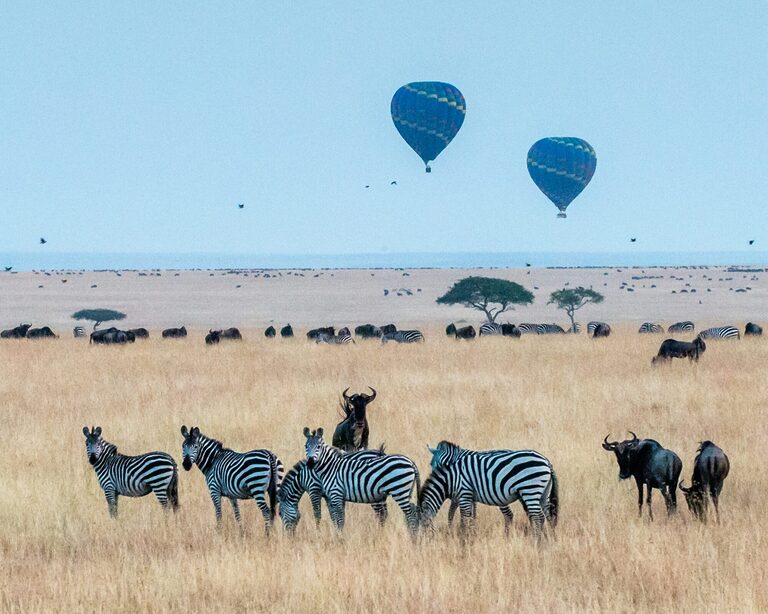
The annual Great Wildebeest Migration is one of the worlds greatest wildlife events. Over two million wildebeests and zebras move from Tanzania’s Serengeti into Kenya’s Masai Mara in search of fresh grazing. The Mara River crossings are the defining moment of the entire spectacle. Watching enormous herds launch themselves into crocodile-infested water is chaotic, dramatic and unforgettable in equal measure.
The migration runs between July and October and planning your visit around this window is strongly recommended for first-time travellers. Even outside of the river crossings, the sheer volume of wildlife concentrated in the Mara during this period makes for extraordinary game viewing at every turn.
3. Year-Round Wildlife Viewing
One of Kenya’s most practical advantages over other safari destinations is that wildlife experiences are across different seasons. The country’s varied climate means animals are visible and active throughout the year, just behaving differently depending on conditions.
During the dry season, animals gather around watering holes in predictable patterns, making sightings easier to plan for. In the wet season, lush vegetation draws certain species into the open and the landscapes become dramatically photogenic. For wildlife photographers especially, the green season produces some of the most striking images, with vivid backdrops that the dry season simply cannot match.
4. Many National Parks to Explore
Kenya has 24 national parks and each one has its own distinct personality. Beyond the world-famous Masai Mara, a few deserve particular attention from travellers planning their itinerary.
- Amboseli National Park is famous for its large elephant herds and offers one of Africa’s most iconic views. Here, elephants move across open plains with Mount Kilimanjaro rising in the background.
- Nairobi National Park is unique because it is the only national park in the world located within a capital city. It is to lions, giraffes, antelopes and over 500 bird species. It is also an easily accessible option for travellers with limited time.
- Tsavo East and West National Parks sit within easy reach of the Kenyan coast and are ideal for anyone wanting to combine a game drive with a beach stay
This variety means Kenya can accommodate different budgets, travel styles and itineraries without ever feeling like you’re compromising.
5. Unique Safari Lodges and Camps
Kenya’s safari accommodation is genuinely world-class. The country now offers lodges and camps that place you directly inside wildlife areas, making the natural environment part of your stay rather than just a backdrop for day trips.
The JW Marriott Masai Mara sits within the Masai Mara National Reserve and is positioned near an active migration route. This means animals are sometimes visible from the property itself. Salt Lick Safari Lodge in Taita-Taveta takes a different approach. Its 96 rooms are built on stilts above a watering hole, so wildlife effectively comes to you. Then there is Giraffe Manor in Nairobi, where Rothschild giraffes, a critically endangered species, lean through windows at breakfast and can be hand-fed from the dining table.
6. Diverse and Dramatic Landscapes
Kenya’s geography is one of its most underrated qualities. The country spans a remarkable range of environments and travelling between them is part of what makes a Kenyan trip feel so varied.
Head south from Nairobi towards Amboseli and the golden grasslands stretch to the horizon, turning lush green during the rainy season. Travel north into Samburu and the terrain shifts to a rugged, semi-arid landscape. It is dominated by Mt Ololokwe, a flat-topped mountain considered sacred by the local Samburu people and popular with photographers for its striking formation. The Great Rift Valley cuts through the country with dramatic effect and Lake Nakuru, seasonally fringed with flamingos, offers outstanding photographic opportunities. Mount Kenya itself, Africa’s second-highest peak, is best captured on an early sunny morning when its snow-capped summit catches the light cleanly.
7. Masai Culture and Community Visits
Kenya’s wildlife draws most of the attention but the human stories running alongside it add a depth that many travellers do not fully anticipate before they arrive. The Masai, living across parts of Kenya and Tanzania, are among the few African communities that have maintained their traditional way of life with remarkable consistency.
A visit to a Masai community offers genuine insight into customs passed down through generations. Travellers can learn how to start a fire without matches, observe the construction of traditional homes and receive blessings from community elders. Masai women are skilled craftspeople and create colourful beadwork such as bracelets, necklaces and other pieces. These make meaningful souvenirs that directly support the communities producing them. These visits are most rewarding when arranged through responsible operators who ensure the community benefits fairly from tourism.
8. Rare Wildlife Found Nowhere Else
Beyond the Big 5, Kenya is home to species that are rare or found in very few places elsewhere on Earth. Researchers have documented and photographed black leopards in Laikipia County. They are a melanistic variation caused by a genetic mutation and represent one of the most unusual wildlife encounters possible anywhere in the world.
Samburu National Park is the place to find the Samburu Special Five (the reticulated giraffe, Grevy’s zebra, Somali ostrich, gerenuk and Beisa oryx). These species thrive in the arid north and do not occur in the Masai Mara, which is reason enough to include Samburu on any serious safari itinerary. The Mount Kenya Wildlife Conservancy in Nanyuki cares for the critically endangered Mountain Bongo, Africa’s rarest antelope, as part of an active breeding and reintroduction programme. Kenya also shelters the Sokoke Scops Owl, one of the world’s rarest bird species, in the coastal forests near Watamu.
9. World-Class Conservation
Kenya’s commitment to conservation is one of the most impressive on the continent. According to the International Fund for Animal Welfare, approximately 12% of Kenya’s land mass is under some form of protection, managed by the government, community-led conservancies or private game reserves, creating a network that supports long-term wildlife survival across enormous areas.
Lewa Conservancy, covering 65,000 acres, holds the highest concentration of Grevy’s zebras anywhere in the world. Ol Pejeta Conservancy in Nanyuki cares for endangered chimpanzees, black and white rhinos and African wild dogs. It also offers accommodation options such as Sweetwaters Serena Camp for visitors wanting to stay within the conservancy after a game drive. Choosing Kenya as your safari destination is, in many ways, a direct contribution to this conservation infrastructure.
10. Combining Safari and Beach in One Trip
Kenya offers something that few safari destinations can genuinely match, the ability to pair a proper wildlife experience with a beach holiday without complicated logistics or long-haul domestic travel. The Kenyan coast, stretching through Mombasa, Diani, Watamu and Malindi, offers beautiful beaches alongside snorkelling, dolphin watching and boat excursions on the Indian Ocean.
Diani Beach has been recognised as Africa’s leading beach destination by the World Travel Awards for eight consecutive years, a track record that reflects consistent quality rather than a one-off accolade. Tsavo East and West National Parks sit within roughly three and a half hours of the Mombasa beaches, making a safari-to-coast transition both practical and satisfying within a single trip.
Frequently Asked Questions
Kenya offers wildlife experiences year-round but the most popular window is July to October, when the Great Wildebeest Migration is active in the Masai Mara. The dry season from June to October and January to February generally produces the most reliable game viewing overall.
Kenya is one of Africa’s most visited destinations and has well-established tourism infrastructure. As with any destination, it’s sensible to follow current travel advice and book through reputable operators. The Masai Mara, Amboseli and the major parks are all well-accustomed to hosting international visitors.
A minimum of five to seven days allows you to cover two or three parks without feeling rushed. If you’re combining safari with a beach stay, ten to fourteen days gives a more comfortable balance.
The Masai Mara is widely considered the best starting point. It offers outstanding Big 5 sightings, experienced guiding and accommodation options across a wide range of budgets.
Most nationalities require an Electronic Travel Authorisation (eTA), which replaced the previous e-visa system and can be applied for online before departure. Always check the latest entry requirements based on your passport and nationality.
Final Thoughts
Rarely will you find a safari destination as consistently rewarding as Kenya. The country delivers on wildlife, landscapes, culture and beaches often within a single well-planned trip. Whether you’re a first-time safari traveller or someone returning to Africa for another look, Kenya offers the kind of depth and variety that keeps drawing people back. It is no surprise that according to Statista, nearly two million international tourists made the journey in 2023 alone. Those numbers reflect a destination that genuinely earns its reputation. Visit once and it is easy to understand why people keep coming back.