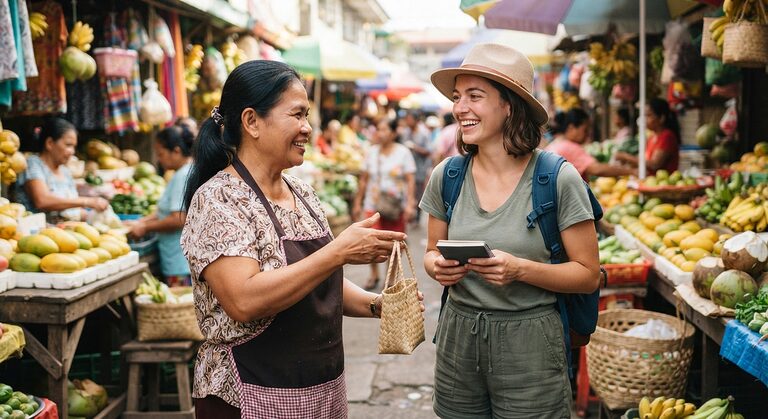
So, you are travelling to the Philippines.
You have packed your sunscreen, booked your island-hopping adventures and possibly spent several evenings looking at photographs of Palawan while pretending to do something productive.
But have you learnt a little Filipino?
Fortunately, travelling around the Philippines without speaking the local language is relatively straightforward.
English is widely spoken, particularly in major cities, hotels, restaurants and popular tourist destinations.
However, learning a few local phrases can make your experience considerably more enjoyable.
It can help you negotiate prices at local markets, order delicious Filipino food, ask for directions and connect with the wonderfully welcoming people you meet along the way.
And sometimes, simply saying thank you in Filipino can earn you a smile that makes the entire effort worthwhile.
The Philippines is home to numerous languages, including Cebuano, Ilocano, Hiligaynon, Waray and Kapampangan. Filipino, which is largely based on Tagalog, is the national language and is widely understood across the country.
You do not need to master complicated grammar before your holiday.
Nobody expects you to arrive speaking fluent Filipino.
Although if you manage to sing an entire Filipino karaoke song, you may achieve an entirely different level of appreciation.
To help you communicate with confidence, here are 10 useful Filipino phrases every traveller should know, complete with simple pronunciation guides.
1. Kumusta? (Hello / How Are You?)
🗣️ Filipino: Kumusta?
Pronunciation: koo-moos-TAH
Meaning: Hello / How are you?
Let’s begin with one of the simplest and most useful Filipino greetings.
Kumusta? is a friendly way to greet somebody and ask how they are doing.
You may notice that it sounds remarkably similar to the Spanish phrase ¿Cómo estás?
That is no coincidence.
More than three centuries of Spanish colonial rule left a significant influence on Filipino vocabulary.
You can use this greeting when meeting your tour guide, speaking to your accommodation host or starting a conversation with a local shopkeeper.
If you want to sound particularly polite, you can say Kumusta po?
The word po is commonly used to show respect, especially when speaking to older people.
💡 Travel Tip: A friendly smile combined with Kumusta po? is an excellent way to begin a conversation.
Filipinos are generally very sociable, so do not be surprised if your simple greeting develops into a conversation about where you are from, how long you are staying and whether you have tried Filipino food.
And whether you have eaten yet.
That question is practically inevitable.
2. Magandang Umaga (Good Morning)
🌅 Filipino: Magandang umaga
Pronunciation: mah-gahn-DAHNG oo-MAH-gah
Meaning: Good morning
There is something particularly wonderful about mornings in the Philippines.
The smell of freshly baked pandesal.
The sound of waves along the coastline.
The aroma of garlic rice being prepared for breakfast.
And occasionally, a neighbourhood rooster announcing the beginning of the day considerably earlier than you had intended.
Magandang umaga is a polite and friendly morning greeting.
It is useful when entering a café, greeting hotel staff or meeting your guide before an early morning excursion.
You can also adapt your greeting depending on the time of day:
| Filipino phrase | Pronunciation | Meaning |
| Magandang umaga | mah-gahn-DAHNG oo-MAH-gah | Good morning |
| Magandang tanghali | mah-gahn-DAHNG tahng-HAH-lee | Good midday |
| Magandang hapon | mah-gahn-DAHNG HAH-pon | Good afternoon |
| Magandang gabi | mah-gahn-DAHNG gah-BEE | Good evening |
💡 Travel Tip: Add po at the end of your greeting to make it more respectful.
For example, Magandang umaga po is a lovely way to greet somebody politely.
It requires very little effort and can make everyday interactions feel considerably warmer.
Even if you are still recovering from that 4 am airport transfer.
3. Salamat Po (Thank You)
🙏 Filipino: Salamat po
Pronunciation: sah-LAH-maht poh
Meaning: Thank you (polite)
If you only learn one Filipino phrase before visiting the Philippines, make it this one.
Salamat means thank you.
Adding po makes the expression more polite and respectful.
You will find countless opportunities to use it throughout your holiday.
When somebody helps you with your luggage, when a tricycle driver takes you to your destination.
When a local recommends a beautiful beach that you would never have discovered otherwise.
Or when somebody serves you an enormous plate of delicious food.
Which may happen considerably more often than you expect.
If you want to express even greater appreciation, you can say:
Maraming salamat po
Pronunciation: mah-RAH-ming sah-LAH-maht poh
Meaning: Thank you very much.
You may receive the response Walang anuman, which means you are welcome.
💡 Travel Tip: Use salamat po whenever somebody helps you, even if the entire conversation has taken place in English.
It is a small gesture that demonstrates appreciation for the local culture.
And unlike your suitcase, gratitude has no baggage allowance.
You can bring as much as you like.
4. Magkano Po Ito? (How Much Is This?)
💰 Filipino: Magkano po ito?
Pronunciation: mahg-KAH-noh poh ee-TOH
Meaning: How much is this?
The Philippines offers some wonderful shopping opportunities.
Colourful local markets.
Handmade souvenirs.
Fresh tropical fruit.
Beautiful woven products.
And an impressive selection of snacks that you may suddenly feel are essential to your survival.
Knowing how to ask the price of something is particularly useful when shopping at markets, roadside stalls and smaller local establishments.
Magkano po ito? allows you to politely ask how much an item costs.
If you are pointing at something slightly farther away, you can say Magkano po iyan? (How much is that?).
Another useful phrase is:
May tawad po ba?
Pronunciation: my TAH-wahd poh bah
Meaning: Is there a discount? / Can the price be reduced?
Bargaining may be acceptable in certain markets and informal shopping environments.
However, it is not appropriate everywhere.
Supermarkets, shopping centres and businesses with clearly displayed fixed prices generally do not expect customers to negotiate.
💡 Travel Tip: Confirm prices before purchasing goods, accepting transport services or booking activities.
If bargaining is appropriate, negotiate politely and remember that many small vendors depend on their daily earnings.
Saving a few pesos is wonderful.
Turning the purchase of a refrigerator magnet into an international diplomatic negotiation is probably unnecessary.
5. Saan Po Ang CR? (Where Is The Toilet?)
🚻 Filipino: Saan po ang CR?
Pronunciation: sah-AHN poh ahng see-ahr
Meaning: Where is the toilet?
There are many useful phrases to learn before travelling.
However, this particular phrase can suddenly become the most important sentence in your entire vocabulary.
Especially after a large Filipino breakfast, two cups of coffee and a particularly enthusiastic sampling of local street food.
In the Philippines, toilets are commonly referred to as comfort rooms.
Usually shortened to CR.
You will see signs displaying CR in shopping centres, restaurants, airports, ferry terminals and public establishments.
Asking Saan po ang CR? is a polite and practical way to find the nearest toilet.
You may also find these directional words useful:
| Filipino word | Pronunciation | Meaning |
| Kaliwa | kah-lee-WAH | Left |
| Kanan | KAH-nahn | Right |
| Diretso | dee-RET-soh | Straight ahead |
| Dito | dee-TOH | Here |
| Doon | doh-OHN | There |
💡 Travel Tip: Carry a small packet of tissues, hand sanitiser and a few coins when travelling around the Philippines.
Some public toilets charge a small fee, while others may not provide toilet paper or soap.
This is particularly worth remembering when visiting remote islands, public markets and provincial bus terminals.
It is not the most glamorous travel preparation.
But neither is discovering an empty toilet paper dispenser at a particularly inconvenient moment.
6. Paano Po Pumunta Sa…? (How Do I Get To…?)
🗺️ Filipino: Paano po pumunta sa…?
Pronunciation: pah-AH-noh poh poo-MOON-tah sah
Meaning: How do I get to…?
The Philippines is an extraordinary country to explore.
However, navigating its thousands of islands, busy cities and winding provincial roads can occasionally become an adventure of its own.
Your navigation app may confidently direct you towards a road that appears to lead to your destination.
Only for you to discover that the road ends at somebody’s vegetable garden.
This is where asking a local becomes particularly useful.
Paano po pumunta sa…? allows you to ask how to reach a particular destination.
For example:
- Paano po pumunta sa airport? (How do I get to the airport?)
- Paano po pumunta sa beach? (How do I get to the beach?)
- Paano po pumunta sa palengke? (How do I get to the market?)
- Paano po pumunta sa hotel? (How do I get to the hotel?)
Filipinos frequently mix English and Filipino in everyday conversations.
This is commonly known as Taglish when Tagalog and English are combined.
So you do not need to translate every destination into Filipino.
💡 Travel Tip: Save the name and address of your accommodation on your phone and download offline maps before travelling to remote areas.
If you are unsure about directions, show somebody the destination on your phone.
Local people can often recommend the most practical transport option, whether that involves a jeepney, tricycle, bus or passenger van.
And if somebody tells you that your destination is malapit lang, meaning it is just nearby, you may wish to ask exactly how far.
The definition of nearby can occasionally be surprisingly flexible.
7. Pabili Po (I’d Like To Buy Something, Please)
🛍️ Filipino: Pabili po
Pronunciation: pah-bee-LEE poh
Meaning: I’d like to buy something, please
One of the most charming features of everyday life in the Philippines is the sari-sari store.
These small neighbourhood shops can be found throughout the country, selling everything from snacks and drinks to toiletries and household essentials.
They are particularly useful when you need a bottle of water, a quick snack or something you forgot to pack.
And despite their modest size, they can contain a surprisingly impressive selection of products.
Pabili po is a common and polite expression used when you want to purchase something.
It is particularly useful when approaching a sari-sari store or a small food stall.
You can follow it with the name of the item you want.
For example:
- Pabili po ng tubig. (I’d like to buy some water, please.)
- Pabili po ng kape. (I’d like to buy some coffee, please.)
- Pabili po ng tinapay. (I’d like to buy some bread, please.)
- Pabili po ng mangga. (I’d like to buy some mangoes, please.)
You may also hear locals saying Tao po! to attract somebody’s attention when approaching a shop or home where nobody is immediately visible.
💡 Travel Tip: Carry small denominations of Philippine pesos when shopping at local stores.
Smaller businesses may not accept cards or have enough change for large banknotes.
And while you are there, consider trying some local snacks.
You may enter a sari-sari store intending to purchase a bottle of water.
And leave with banana chips, biscuits, dried mangoes and several snacks whose names you cannot pronounce.
This is called cultural exploration.
At least, that is what you can tell yourself.
8. Masarap! (Delicious!)
🍽️ Filipino: Masarap!
Pronunciation: mah-sah-RAHP
Meaning: Delicious!
You are going to need this phrase.
Probably quite frequently.
Filipino cuisine offers an extraordinary variety of flavours, from savoury adobo and comforting sinigang to crispy lechon, sizzling sisig and refreshing halo-halo.
Food is an important part of Filipino culture.
Meals bring families together, celebrations often revolve around food and visitors are frequently encouraged to eat more.
Even when they have already eaten considerably more than originally intended.
Saying Masarap! is a simple way to compliment the food.
If you want to express even more enthusiasm, you can say:
Ang sarap!
Pronunciation: ahng sah-RAHP
Meaning: So delicious!
Or:
Masarap po ang pagkain.
Pronunciation: mah-sah-RAHP poh ahng pahg-KAH-een
Meaning: The food is delicious.
You may also hear the expression Kain tayo!, which means let’s eat.
It is a friendly invitation to share a meal and a wonderful example of Filipino hospitality.
💡 Travel Tip: Learn a few additional food-related expressions, particularly if you have dietary preferences or restrictions.
| Filipino phrase | Pronunciation | Meaning |
| Hindi po maanghang | hin-DEE poh mah-ahng-HAHNG | Not spicy, please |
| May karne po ba ito? | my KAR-neh poh bah ee-TOH | Does this contain meat? |
| Tubig po, please | too-BIG poh, please | Water, please |
| Busog na po ako | boo-SOG nah poh ah-KOH | I am already full |
If you have a serious food allergy, carry a translated allergy card and confirm ingredients carefully before eating.
And remember that saying you are full may not always prevent somebody from offering you another serving.
Especially if there is still food on the table.
9. Para Po! (Please Stop Here!)
🚐 Filipino: Para po!
Pronunciation: pah-RAH poh
Meaning: Please stop here!
Travelling around the Philippines would not be quite the same without experiencing some of its local transport.
Jeepneys are colourful, affordable and an iconic part of Philippine culture.
However, unlike many public transport systems elsewhere in the world, traditional jeepneys do not always have clearly marked stops or automatic announcements telling you when to get off.
Which means you may need to inform the driver yourself.
This is where Para po! becomes extremely useful.
It is commonly used to ask a jeepney driver to stop at a suitable location.
Another phrase you may hear frequently while riding a jeepney is:
Bayad po!
Pronunciation: BAH-yahd poh
Meaning: Fare payment, please.
Passengers sometimes pass their fare through other passengers until it reaches the driver.
You may also hear:
Pakisuyo po.
Pronunciation: pah-kee-SOO-yoh poh
Meaning: Please do me a favour.
This can be used politely when asking somebody to pass your fare to the driver.
💡 Travel Tip: Before boarding a jeepney, confirm that it travels towards your intended destination.
Carry small notes or coins and keep an eye on your location using offline maps.
Ask the driver or another passenger to let you know when you are approaching your stop if you are unfamiliar with the route.
When it is time to get off, say Para po! clearly and allow the driver to find a safe and permitted stopping point.
Do not wait until you have travelled several kilometres beyond your destination.
Although you may accidentally discover an entirely new neighbourhood.
Which is certainly one way to expand your sightseeing itinerary.
10. Tulungan N’yo Po Ako (Please Help Me)
🆘 Filipino: Tulungan n’yo po ako
Pronunciation: too-LOO-ngahn nyoh poh ah-KOH
Meaning: Please help me
Nobody likes to imagine encountering difficulties during a holiday.
However, knowing how to ask for assistance is an important part of travelling responsibly.
You might lose your belongings, become separated from your travel companions, feel unwell or simply find yourself somewhere unfamiliar.
In these situations, Tulungan n’yo po ako is a useful phrase for politely requesting help.
In an urgent situation, you can simply shout:
Tulong!
Pronunciation: too-LONG
Meaning: Help!
Here are a few additional phrases that may be useful during an emergency:
| Filipino phrase | Pronunciation | Meaning |
| Nawawala po ako | nah-wah-WAH-lah poh ah-KOH | I am lost |
| Kailangan ko po ng doktor | kah-ee-LAH-ngahn koh poh nahng dok-TOR | I need a doctor |
| Saan po ang ospital? | sah-AHN poh ahng os-pee-TAHL | Where is the hospital? |
| Tumawag po kayo ng pulis | too-MAH-wahg poh KAH-yoh nahng poo-LEES | Please call the police |
| Hindi po maganda ang pakiramdam ko | hin-DEE poh mah-gahn-DAH ahng pah-kee-RAHM-dahm koh | I am not feeling well |
The Philippines uses 911 as its national emergency hotline.
However, response times and service availability can vary by location, particularly in remote areas.
💡 Travel Tip: Save important emergency contact numbers, your accommodation details, travel insurance information and the contact details of your embassy or consulate before travelling.
Keep offline copies of these details in case you lose internet access.
If you are visiting remote islands or participating in adventurous activities, familiarise yourself with the nearest medical facilities.
Hopefully, you will never need these phrases.
But much like travel insurance and waterproof bags, they are considerably better to have and not need than to need and not have.
🇵🇭 Bonus Language Tips For Travellers To The Philippines
Before you begin practising your Filipino phrases, here are a few additional language tips worth remembering.
Understand The Importance Of Po And Opo
Two words you will frequently hear in the Philippines are po and opo.
They are particularly common in Tagalog-speaking communities and are used to express politeness and respect.
Po (pronounced poh) is added to sentences to make them more respectful.
Opo (pronounced oh-POH) is a polite way of saying yes.
For example:
| Informal expression | Polite expression | Meaning |
| Salamat | Salamat po | Thank you |
| Oo | Opo | Yes |
| Hindi | Hindi po | No |
| Kumusta? | Kumusta po? | How are you? |
| Magkano? | Magkano po? | How much? |
You do not need to add po to absolutely every sentence.
But using it when speaking to older people, shopkeepers, accommodation hosts and strangers is generally a thoughtful gesture.
A little politeness can travel a remarkably long way.
Remember That The Philippines Has Many Regional Languages
Although Filipino is widely understood, it is not the first language of everybody in the Philippines.
Travel around the country and you will encounter different languages, expressions and accents.
For example:
| Language | Thank you | Commonly spoken in |
| Filipino/Tagalog | Salamat | Metro Manila and much of Central and Southern Luzon |
| Cebuano | Salamat | Cebu, Bohol and large parts of Mindanao |
| Ilocano | Agyamanak | Northern Luzon |
| Hiligaynon | Salamat | Iloilo and parts of Negros |
| Waray | Salamat | Samar and parts of Leyte |
| Kapampangan | Dakal a salamat | Pampanga and surrounding areas |
If you are travelling to Cebu, Bohol, Siargao or Davao, you may frequently hear Cebuano, also commonly referred to as Bisaya.
A few useful Cebuano expressions include:
- Maayong buntag (mah-AH-yong BOON-tahg): Good morning.
- Daghang salamat (DAHG-hahng sah-LAH-maht): Thank you very much.
- Pila ni? (pee-LAH nee): How much is this?
- Amping (AHM-ping): Take care.
Learning a few regional expressions can make your interactions even more meaningful.
And you may discover that your Filipino vocabulary expands naturally as you travel from one island to another.
Do Not Worry Too Much About Perfect Pronunciation
Filipino pronunciation is generally approachable for English-speaking travellers.
Many words are pronounced relatively closely to how they are written.
However, syllable stress and certain sounds can affect meaning.
Here are a few basic pronunciation tips:
- A sounds like the a in father.
- E sounds like the e in bed.
- I sounds like the ee in see.
- O sounds like a short, pure oh.
- U sounds like the oo in food.
- NG sounds like the ending of the English word sing.
The capitalised syllables in the pronunciation guides throughout this article indicate where the emphasis generally falls.
Listen carefully to how local people pronounce words and try to imitate them.
Do not be embarrassed if you make mistakes.
Most people will appreciate your effort and may happily help you improve.
You are learning a language while travelling.
Not sitting an examination.
English Is Widely Spoken, So Use It When Necessary
One of the great advantages of visiting the Philippines is that English is widely used in education, business, tourism and everyday communication.
You may notice that conversations frequently switch between English and local languages.
Sometimes within the same sentence.
Sometimes several times within the same sentence.
This is perfectly normal.
If you forget a Filipino word, feel free to use English.
The purpose of learning these phrases is to make communication easier and create more meaningful connections.
Not to spend 15 minutes attempting to remember the Filipino word for a spoon while your dinner gets cold.
🌺 Final Philippines Thoughts
Learning a few useful Filipino phrases before travelling to the Philippines can make your adventure considerably more rewarding.
You do not need to become fluent.
You do not need to memorise an entire dictionary.
And you certainly do not need to understand every conversation taking place inside a crowded jeepney.
A few simple expressions can make an enormous difference.
Greet somebody with Kumusta po?
Start your morning with Magandang umaga.
Show your appreciation with Salamat po.
Ask about prices with Magkano po ito?
Compliment a delicious meal with Masarap!
And remember Para po! before your jeepney travels considerably farther than intended.
The beauty of learning a local language is that it opens doors to experiences that go beyond ordinary sightseeing.
You might discover a wonderful local restaurant because you asked somebody for directions, you might share a laugh with a market vendor while attempting to pronounce a Filipino phrase.
You might receive an unexpected invitation to join a family meal.
Or you might find yourself practising Cebuano with a friendly local while waiting for a ferry to your next island.
These are often the moments that make travelling truly memorable.
The Philippines is a country where hospitality, humour, family and community are deeply woven into everyday life.
And while its spectacular beaches, mountains and tropical landscapes may initially attract you, the connections you make with its people may become some of your most treasured memories.
So pack your bags.
Practise your pronunciation.
Bring your curiosity and sense of humour.
Do not be afraid to make mistakes.
And remember one final Filipino expression:
Ingat!
Pronunciation: ee-NGAHT
Meaning: Take care!
A simple expression that perfectly captures the warmth you may encounter throughout your Philippine adventure.
Maraming salamat at maligayang paglalakbay!
Thank you very much and happy travels! 🇵🇭