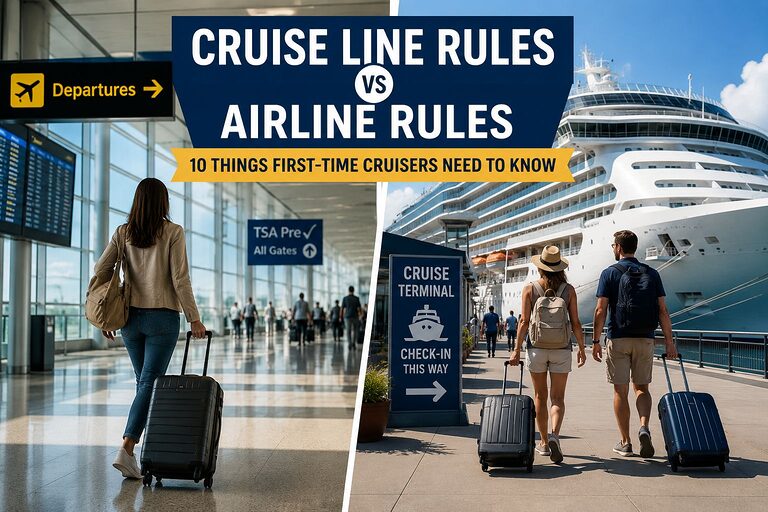
If this is your first cruise, you might expect embarkation to feel exactly like catching a flight. In reality, cruise line rules vs airline rules differ in several important ways, from how your luggage is handled to what happens if you turn up late. Understanding these differences before you leave home can help you pack smarter, avoid unexpected costs and start your holiday feeling relaxed rather than caught off guard.
While the boarding process may look familiar, cruise lines operate very differently from airlines. Knowing these differences before you travel can help you avoid delays, unexpected expenses and unnecessary stress on embarkation day.
Here are ten important ways cruise line rules differ from airline rules. Knowing them can make your holiday start far more smoothly.
1. Cruise Ships Don’t Wait for Late Passengers
Airlines routinely deal with delayed passengers, missed connections and flight changes, often offering rebooking options when disruptions occur.
Cruise ships operate on fixed sailing schedules. Once the gangway is raised and the ship receives clearance to depart, it leaves, whether every passenger has arrived or not.
If your flight is delayed or traffic causes you to miss embarkation, you may need to catch up with the ship at the next port, often at your own expense.
Travel tip: Whenever possible, arrive in your departure city at least one day before your cruise.
2. Your Checked Luggage Doesn’t Arrive Immediately
After a flight, your checked bags typically appear on the baggage carousel relatively quickly.
On a cruise, luggage is collected at the terminal, screened and delivered directly to your cabin. Depending on boarding times and the size of the ship, this can take several hours.
Keep medications, passports, chargers, valuables and a change of clothes in your carry-on bag so you have everything you need until your luggage arrives.
New tip: Pack a small, refillable water bottle and a light snack in your carry-on too. Dining venues are not always open the moment you board. Staying hydrated after a long travel day makes a real difference.
3. Cruise Lines Have Different Packing Rules
Items that are perfectly acceptable on an aeroplane may not be allowed on a cruise ship.
Many cruise lines prohibit or restrict items such as:
- Surge-protected power strips
- Clothing irons and steamers
- Candles and open flames
- Certain cooking appliances
- Large quantities of alcohol
These policies are designed to improve safety for thousands of passengers and crew living together onboard.
If you are unsure what items are not allowed on a cruise, checking a detailed packing guide before departure can help you avoid having belongings confiscated or delayed during embarkation.
Always review your cruise line’s prohibited items list before packing.
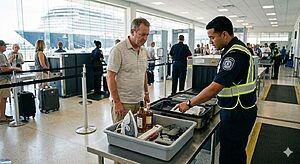
4. Security Looks for Different Risks
Airport security is primarily focused on aviation safety.
Cruise terminal security focuses on maintaining a safe environment aboard the ship throughout the voyage.
Because of this, some items commonly accepted during air travel may be held by the cruise line until the end of the voyage or denied boarding altogether.
Don’t assume that because something is allowed on an aeroplane, it will automatically be permitted on a cruise ship.
5. Alcohol Policies Are Usually More Restrictive
Many airlines allow passengers to transport alcohol in checked baggage, provided it complies with airline and customs regulations.
Cruise lines often limit how much alcohol passengers may bring onboard. Some allow each adult to bring one bottle of wine, while others prohibit outside alcoholic beverages altogether.
If alcohol exceeds your cruise line’s allowance, it may be confiscated and returned at the end of your voyage.
6. International Cruises Have Additional Documentation Requirements
For many domestic flights, a government-issued photo ID may be all you need, depending on local regulations.
International cruises almost always require a valid passport. Documentation requirements can vary depending on your itinerary, nationality and ports of call.
Before travelling, it’s worth reviewing the latest cruise ID requirements to ensure you have the proper documentation for your sailing.
Travellers should also check the U.S. Department of State Travel Advisories for destination-specific entry requirements, travel alerts and safety information before departure.
7. One Cruise Can Visit Multiple Countries
Most flights take you to a single destination.
A cruise may visit several countries during one itinerary, each with different customs regulations, entry requirements and local laws.
Taking a few minutes to research each destination before you sail can help you avoid unexpected issues while ashore.
First-time cruisers who are still planning their itinerary may also benefit from exploring some of the best cruise ship destinations, as different routes offer very different cultural experiences, climates and shore excursions.
New tip: Keep a printed or offline copy of each port’s currency, tipping customs and basic phrases. Small local shops and taxi drivers do not always accept cards, so having a little local cash on hand can save time and hassle.
8. Internet Access Is Different at Sea
Most airports now offer free Wi-Fi.
Cruise ships rely primarily on satellite internet, which may require purchasing a package and can be slower than expected, especially while the ship is at sea.
Download maps, reservation confirmations, boarding passes and important travel documents before you leave home whenever possible.
9. Medical Care Is More Limited
Airports have nearby hospitals and emergency services readily available.
Cruise ships have onboard medical centres staffed by qualified professionals, but treatment options are naturally more limited than those available at a land-based hospital.
Comprehensive travel insurance can provide valuable protection if you experience a medical emergency or need evacuation during your trip.
10. Embarkation Is Part of the Holiday
Flying is simply transportation from one place to another.
Cruise embarkation is the beginning of the holiday itself.
You’ll explore the ship, enjoy your first meal, settle into your cabin, attend the mandatory safety drill and begin experiencing everything your cruise has to offer long before the ship leaves port.
Arriving prepared allows you to enjoy embarkation instead of worrying about forgotten documents or prohibited items.
Cruise vs Airline Rules: Quick Comparison
| Rule | Airlines | Cruise Lines |
| Late arrival | Passengers can often rebook a later flight | Ship departs on schedule and latecomers may miss the sailing |
| Luggage delivery | Bags arrive relatively quickly at the carousel | Bags are delivered to your cabin and can take several hours |
| Alcohol allowance | Permitted in checked bags within customs limits | Often limited to one bottle per adult or banned outright |
| Documentation | Photo ID accepted for domestic flights | Passport usually required, even for round-trip sailings |
| Internet access | Free Wi-Fi at most airports | Paid satellite packages that are often slower |
| Medical care | Hospitals are nearby | Onboard medical centre with limited treatment options |
FAQ: Cruise Line Rules vs Airline Rules
In some cases, no. Many cruise lines will accept a birth certificate and photo ID for closed-loop sailings, but a passport is strongly recommended in case of a medical disembarkation or a missed ship at a foreign port.
You are responsible for arranging your own transport and costs to rejoin the ship at the next port. Keeping the ship’s contact details and port agent information handy can help if this happens.
Most cruise lines allow a limited amount, often one bottle of wine per adult at embarkation, while spirits and beer are usually restricted or must be purchased onboard.
Rarely. Most cruise lines charge separately for internet packages. Speeds can vary depending on the ship’s location at sea.
Final Thoughts
Although cruises and flights share some similarities, they operate under very different rules.
Knowing what to expect before you arrive at the terminal can help you pack smarter, prepare the right documents, avoid common mistakes and enjoy a smoother embarkation experience.
For first-time cruisers especially, a little preparation goes a long way toward making embarkation smooth and enjoyable, so you can focus on what matters most: relaxing and making the most of your time at sea.