Introduction
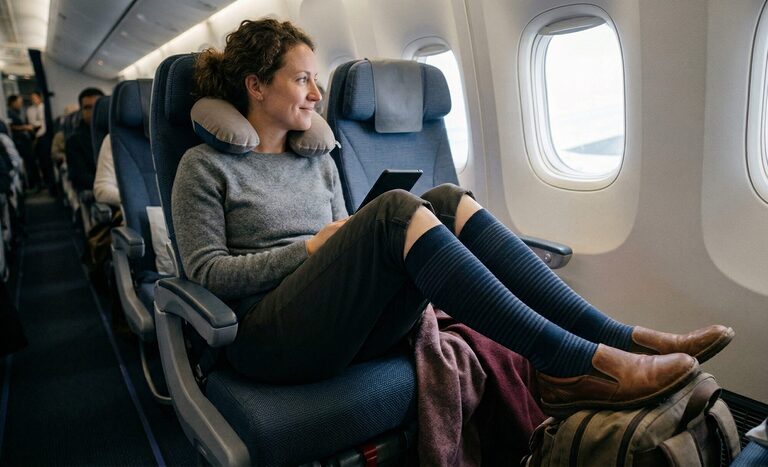
Compression socks are a type of travel accessory designed to support circulation in the lower legs during long periods of sitting. They apply gentle pressure to the legs, helping blood flow more efficiently and reducing fluid build-up in the feet and ankles.
Travellers often use them on flights, long coach journeys and extended car trips where movement is limited for several hours.
Many travellers also read why you need compression socks on flight to better understand how these benefits apply in real travel situations.
Quick answers
What are Compression socks?
Socks designed to apply controlled pressure to the legs to support circulation and reduce swelling.
Do Compression socks work?
They can help improve blood flow and reduce leg swelling when worn correctly during long periods of sitting.
When should you use Compression socks?
During long journeys of four hours or more where you expect limited movement.
What are Compression socks?
Compression socks are specially designed socks that apply graduated pressure to the lower legs. The pressure is strongest at the ankle and gradually decreases up the leg, supporting blood flow back towards the heart. They are commonly used in travel settings to reduce swelling and discomfort caused by prolonged sitting.
Why travellers use Compression socks?
- Help reduce swelling in feet and ankles during long journeys
- Support circulation when sitting for extended periods
- Reduce feelings of heaviness in the legs after travel
- Help limit blood pooling in the lower legs
- Improve overall comfort during flights and long transport sessions
- Some travellers combine them with movement routines from in-seat exercises to stay comfortable on a flight to further reduce stiffness during long periods of sitting.
Types of Compression socks
Graduated knee-high compression socks*
These are the most common travel option with pressure that decreases up the leg
- Knee-length design
- Graduated compression pattern
- Suitable for long haul flights
Ankle compression socks*
Shorter socks offering lighter support for everyday use
- Lower coverage
- Less effective for swelling prevention
- Easier to wear in casual settings
Thigh-high compression socks*
Extended length socks often used in medical contexts
- Full leg coverage
- Stronger compression options available
- Less commonly used for travel
Comparison table
| Type | Security or function | Visibility or convenience | Best use |
| Graduated knee-high | Balanced circulation support | Moderate visibility under trousers | Long haul flights and coach travel |
| Ankle compression socks | Light support for feet | Low visibility | Everyday wear and short trips |
| Thigh-high socks | Full leg compression support | High visibility and less convenient | Medical or specific circulation needs |
Typical specifications
| Specification | Typical range |
| Length or size | Ankle, knee-high, thigh-high |
| Width | Based on calf circumference 25 to 45 cm |
| Material | Cotton blends, nylon, elastane |
| Closure mechanism | Pull-on stretch fit |
| Weight | 40 g to 120 g per pair |
Materials used
Cotton blend
A soft and breathable material often used for comfort during long journeys
- Breathable feel
- Natural fibre mix
- Comfortable for extended wear
Nylon and elastane
A common performance blend used to create elasticity and compression
- High stretch capacity
- Durable structure
- Maintains consistent pressure
How to choose a Compression socks?
- Select the correct compression level in mmHg based on travel duration and needs (mmHg stands for millimetres of mercury, a unit used to measure pressure in which higher values indicate stronger compression. For most travellers, 15–20 mmHg is the appropriate starting point, while 20–30 mmHg is better for stronger support needs.)
- Ensure proper sizing using calf circumference and shoe size
- Choose knee-high styles for most travel situations
- Look for breathable and moisture-wicking fabrics
- Consider ease of putting them on, especially for firmer compression levels
- Check for seam placement to avoid irritation
- Match cushioning level to footwear comfort needs
Popular brands
Sigvaris
CEP
TravelMore
Frequently asked questions
Most travel compression socks do not require a prescription and are available over the counter.
They can be worn for long periods but should usually be removed after travel or extended sitting.
They should be worn before or at the start of a journey for best effectiveness.
Example travel solution
Some travellers choose knee-high graduated compression socks with 15–20 mmHg support, designed to improve circulation and reduce swelling during long flights and extended periods of sitting.
Summary
Compression socks are a practical travel accessory that help support circulation and reduce swelling during long periods of sitting. They are most effective when correctly fitted, worn from the start of travel and paired with regular movement where possible.
If you want to explore a range of compression socks, I have included a link to Amazon* to help you find a few great options.
*This article contains affiliate links. If you make a purchase, we may earn a small commission at no extra cost to you.