Here’s a practical guide to duffel bag fabrics, one of the most important factors when choosing a durable bag.
Choosing a Duffel Bag — What Really Matters
When people look for the “toughest” duffel, they are often thinking about different types of durability:
● Resistance to abrasion (airport belts, concrete floors)
● Resistance to tearing
● Waterproofness and weather resistance
● Ability to carry heavy loads over time
The best material depends on which of these matters most for your use.
Fabric Toughness (Key Decision)
If durability is your priority, focus on the following characteristics rather than just fabric names.
1) Denier (D) — Thickness of the Yarn
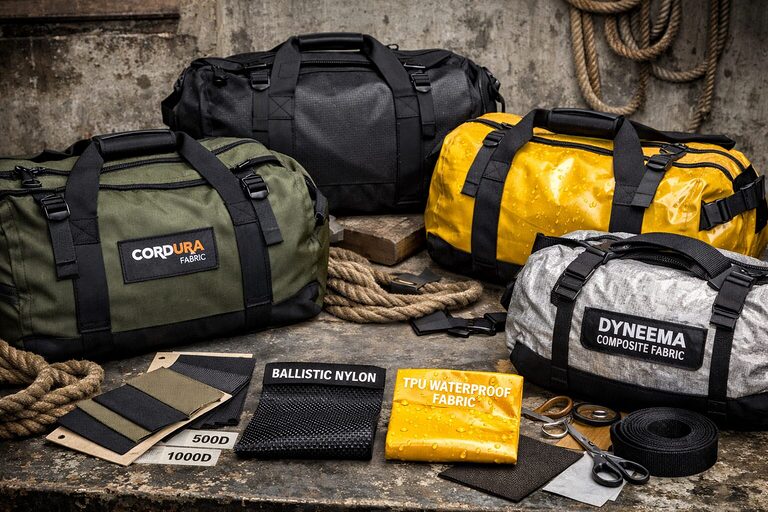
● 500D = strong but lighter
● 1000D+ = very rugged
● Higher denier usually means thicker, tougher, and heavier
For heavy-duty duffels, 700D–1050D is often the practical sweet spot.
2) Abrasion Resistance (Rubbing and Scraping)
General comparison from strongest to more standard:
● Ballistic nylon (very dense weave)
● Cordura nylon
● TPU-laminated expedition fabrics
● Standard polyester
Abrasion resistance matters most for airline travel and rough surfaces.
3) Tear Strength (Snagging or Overloading)
● Dyneema or composite fabrics — exceptional tear resistance
● Cordura nylon — very strong balance
● Ballistic nylon — durable but more rigid
● Canvas or polyester — varies widely by quality
A fabric can feel thick but still tear; fibre quality matters more than thickness alone.
4) Structure vs Flexibility
● Ballistic nylon — stiffer and more structured
● Cordura — flexible and durable, often preferred for travel
● TPU expedition fabrics — extremely tough but more “rubbery”
Excess stiffness can reduce usability, even if the fabric is technically strong.
5) Coatings and Construction
Fabric toughness is not just about the textile itself:
● TPU lamination increases weather and abrasion resistance
● PU coatings add water resistance
● Reinforced base panels can extend lifespan significantly
A well-designed 500D Cordura bag with reinforcement can outlast a poorly made “1680D” polyester duffel.
How Cordura Fits Into Toughness
Cordura is widely seen as one of the best real-world balances between durability and usability:
● High abrasion resistance
● Strong tear resistance
● Flexible and comfortable in daily use
● Premium perception among buyers
For most travellers, a 1000D Cordura duffel is already extremely rugged. It may not be the absolute strongest in every category, but it is one of the most practical durable fabrics available.
Materials Compared — Toughness Overview
Cordura Nylon
● Excellent durability-to-weight ratio
● Suitable for rugged but refined travel use
● Long lifespan without excessive weight
Ballistic Nylon
● Very high abrasion resistance
● Works well for heavy loads and urban abuse
● More structured feel
TPU Expedition Fabrics
● Designed for extreme conditions
● Highly water-resistant and scrape-resistant
● Less flexible and more utilitarian in feel
Dyneema and Composite Fabrics
● Extremely strong fibres with high tear resistance
● Lightweight but expensive
● Often more technical than necessary for heavy duffels
Conclusion
If toughness is your main priority when choosing a duffel:
● Most practical durable choice: 1000D Cordura
● Maximum abrasion resistance: Ballistic nylon
● Extreme expedition durability: TPU-laminated fabrics
Cordura is not always the single toughest material on paper, but it is often the most balanced option for long-term, real-world travel use.
If you want to explore a range of popular travel duffels, I have included a link to Amazon Best Sellers list* to help you find a few great options.
*This article contains affiliate link. If you make a purchase, we may earn a small commission at no extra cost to you.