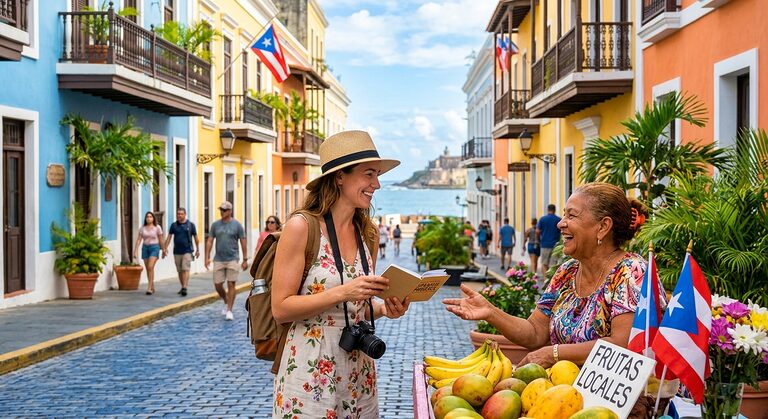
So, you are travelling to Puerto Rico.
Excellent choice.
You are about to discover a beautiful Caribbean island filled with colourful colonial streets, golden beaches, spectacular rainforests, historic Spanish fortresses, delicious food, lively music and some wonderfully warm hospitality.
And then there is the language.
Spanish.
A beautiful, expressive language that sounds wonderfully musical when spoken by locals.
Especially Puerto Ricans.
Who occasionally speak so quickly that your carefully practised Spanish may struggle to keep up.
Fortunately, Puerto Rico is a relatively accessible destination for English-speaking travellers.
English is commonly spoken in hotels, tourist attractions and many businesses, particularly around San Juan.
You can often arrange accommodation, order food and explore popular destinations without speaking much Spanish.
But here is the thing.
Learning a few local phrases can make your travel experience considerably more enjoyable.
A friendly greeting.
A polite thank you.
A simple question.
Or an enthusiastic attempt to order mofongo without accidentally asking for something completely different.
These small efforts can help you connect with locals and experience Puerto Rico beyond the usual tourist attractions.
And Puerto Ricans are often delighted when visitors show genuine interest in their language and culture.
Of course, you do not need to become fluent.
Nobody expects you to deliver an elaborate speech about Caribbean history while ordering your morning coffee.
Although that would certainly make breakfast more interesting.
To help you communicate confidently, navigate everyday situations and enjoy your Caribbean adventure, here are 10 useful Spanish phrases every traveller should know when visiting Puerto Rico.
The pronunciation guides below are simplified for English speakers. Puerto Rican Spanish has its own distinctive accent, expressions and pronunciation patterns, so you may hear some words pronounced differently in everyday conversation.
1. ¡Hola! ¿Cómo estás?: Hello! How Are You?
Spanish: ¡Hola! ¿Cómo estás?
Pronunciation: OH-lah! KOH-moh ehs-TAHS?
Meaning: Hello! How are you?
👋 Every great conversation begins somewhere.
And in Puerto Rico, hola is an excellent place to start.
This simple greeting is widely understood and suitable for everyday situations.
Entering a shop?
Hola.
Meeting your hotel receptionist?
Hola.
Greeting somebody at a local café?
Hola.
Simple.
Friendly.
And considerably more welcoming than approaching somebody and immediately demanding directions to the nearest beach.
You can make your greeting more conversational by adding ¿Cómo estás?
It means “How are you?”
This is an informal expression, suitable for friendly or casual conversations.
When addressing somebody more formally, you can say ¿Cómo está?
You may also hear Puerto Ricans greet each other with ¿Qué tal?, meaning “How’s it going?”
And then there is the wonderfully Puerto Rican expression ¿Qué es la que hay?
A casual way of asking “What’s up?” or “What’s happening?”
Although you probably do not need to use that one during your first conversation with an immigration officer.
💡 Travel Hack: Start conversations with a friendly hola or buenos días.
If somebody asks ¿Cómo estás?, you can reply:
Muy bien, gracias.
Pronunciation: MWEE BYEHN, GRAH-syahs.
Meaning: “Very well, thank you.”
Do not worry about sounding perfect.
A smile and a friendly greeting are already a wonderful start.
And if somebody responds with a long sentence spoken at impressive speed?
Smile.
Listen.
And remember that learning one Spanish phrase does not automatically mean you have enrolled in an advanced language course.
2. Muchas Gracias: Thank You Very Much
Spanish: Muchas gracias
Pronunciation: MOO-chahs GRAH-syahs
Meaning: Thank you very much
🙏 If you only remember one Spanish expression during your Puerto Rican adventure, make it this one.
Muchas gracias.
It is useful almost everywhere.
When somebody helps you find your hotel, when a waiter brings your food, when a shopkeeper answers your question.
When a taxi driver helps with your luggage.
Or when a friendly local gives you directions involving five turns, two traffic lights and a bakery that apparently everybody on the island knows.
Muchas gracias.
Thank you very much.
A small expression with a big impact.
Puerto Rico has a strong tradition of hospitality, and showing appreciation is always a good idea.
You can also simply say gracias, meaning “thank you”.
Both expressions are perfectly appropriate.
And if somebody responds with de nada, they are saying “You’re welcome”.
💡 Travel Hack: Practise saying gracias until it feels natural.
Use it generously when interacting with restaurant staff, shopkeepers, drivers and people who help you during your travels.
You will probably say it more often than almost any other Spanish word.
And unlike the souvenirs you purchase in Old San Juan, gratitude does not take up any luggage space.
Which is convenient.
Because you may already have purchased more Puerto Rican coffee, handmade crafts and fridge magnets than originally planned.
3. Por Favor: Please
Spanish: Por favor
Pronunciation: por fah-VOR
Meaning: Please
😊 Good manners travel well.
And Puerto Rico is no exception.
Por favor is one of the simplest and most useful Spanish expressions you can learn.
It means “please”.
You can use it when ordering food.
Requesting assistance.
Asking for directions.
Or politely explaining that you would prefer your drink without quite so much ice.
Although in the Caribbean heat, you may eventually reconsider that decision.
For example:
Un café, por favor.
“One coffee, please.”
Or:
Agua, por favor.
“Water, please.”
Simple.
Practical.
And considerably more polite than pointing at something and hoping the person understands your intentions.
You can also combine por favor with other useful expressions.
For example:
Ayuda, por favor.
“Help, please.”
💡 Travel Hack: Add por favor to requests whenever appropriate.
Even if the rest of your sentence is in English, using a little Spanish shows courtesy.
For example, you might say:
“One bottle of water, por favor.”
Not grammatically perfect Spanish.
But perfectly understandable in many situations.
And if you accidentally pronounce something incorrectly?
Do not panic.
People will generally understand what you are trying to communicate.
Your effort matters more than sounding like somebody who has spent the last twenty years presenting Spanish-language television programmes.
4. ¿Cuánto Cuesta?: How Much Does It Cost?
Spanish: ¿Cuánto cuesta?
Pronunciation: KWAHN-toh KWEHS-tah?
Meaning: How much does it cost?
💰 Puerto Rico has plenty of opportunities for shopping.
Colourful souvenir shops.
Local markets.
Handmade jewellery.
Traditional crafts.
Puerto Rican coffee.
Art galleries.
Clothing boutiques.
And enough interesting little shops to make your carefully planned holiday budget begin questioning your financial decisions.
One of the most useful phrases to remember is ¿Cuánto cuesta?
How much does it cost?
You can use this expression when asking about the price of souvenirs, clothing, food or other products.
For example:
¿Cuánto cuesta esto?
“How much does this cost?”
You may also hear ¿Cuánto es?, a shorter way of asking how much something costs.
Remember that Puerto Rico uses the United States dollar.
So at least you will not need to master an entirely new currency system.
Unless you are travelling from the UK.
In which case, your brain may still need a moment to convert everything into pounds.
💡 Travel Hack: Learn ¿Cuánto cuesta? before exploring souvenir shops and local markets in Old San Juan.
If you do not understand the spoken price, politely ask the seller to show you the amount.
You can say:
¿Me lo puede escribir, por favor?
Pronunciation: meh loh PWEH-deh ehs-kree-BEER, por fah-VOR?
Meaning: “Could you write it down for me, please?”
Remember that prices in Puerto Rico may have applicable sales tax added.
So the amount displayed is not always the final amount you pay.
And while bargaining may be appropriate in certain informal situations, do not assume every shop expects negotiation.
Sometimes you simply want to purchase a souvenir.
Not begin an international trade negotiation over a five-dollar keyring.
5. ¿Dónde Está El Baño?: Where Is The Toilet?
Spanish: ¿Dónde está el baño?
Pronunciation: DOHN-deh ehs-TAH ehl BAH-nyoh?
Meaning: Where is the toilet?
🚻 There are many important things to learn before travelling abroad.
How to greet people, how to say thank you.
How to ask for directions.
And perhaps most importantly:
How to locate a toilet before the situation becomes urgent.
¿Dónde está el baño? is one of the most practical Spanish phrases you can remember.
It means “Where is the toilet?”
You can use it in restaurants, cafés, museums, shopping centres and other public places.
In Puerto Rico, you may also see signs displaying baños or servicios sanitarios.
Both can refer to toilet facilities.
Public toilets are commonly available in shopping centres, larger restaurants and major tourist attractions.
However, facilities may be less convenient in remote beaches, small villages and certain outdoor destinations.
💡 Travel Hack: Learn this phrase before you actually need it.
Not while desperately searching through your phone’s translation app.
Save it in your notes or take a screenshot.
If you are travelling with children, identify toilet facilities before beginning long sightseeing excursions.
Especially when visiting El Yunque National Forest or exploring remote coastal areas.
Because children have an extraordinary ability to announce that they need the toilet approximately 30 seconds after you have left one.
And somehow, the urgency increases dramatically when the nearest facilities are several kilometres away.
Travel parenting is an adventure of its own.
6. No Entiendo: I Don’t Understand
Spanish: No entiendo
Pronunciation: noh ehn-TYEHN-doh
Meaning: I don’t understand
🗣️ Imagine this.
You have successfully greeted somebody in Spanish, you have said hola, you have smiled confidently.
You are feeling rather pleased with yourself.
Then the person replies.
In Spanish.
A full sentence.
Followed by another sentence.
Possibly a question.
And suddenly your impressive language skills have reached the end of their available resources.
This is where no entiendo becomes extremely useful.
It means “I don’t understand”.
It is a straightforward expression that can help explain why you are looking slightly confused.
You can also say:
No hablo mucho español.
Pronunciation: noh AH-bloh MOO-choh ehs-pah-NYOL.
Meaning: “I don’t speak much Spanish.”
Or ask:
¿Habla inglés?
Pronunciation: AH-blah een-GLEHS?
Meaning: “Do you speak English?”
This is a polite and useful question when speaking with somebody you do not know.
💡 Travel Hack: If somebody speaks Spanish too quickly, politely ask them to slow down.
You can say:
Más despacio, por favor.
Pronunciation: mahs dehs-PAH-syoh, por fah-VOR.
Meaning: “More slowly, please.”
Many people will be happy to help when they understand that you are learning.
Do not feel embarrassed about needing assistance.
Almost every traveller has experienced that awkward moment of smiling enthusiastically at a sentence they did not understand.
Just avoid nodding too confidently.
You might accidentally agree to something.
Like ordering six additional portions of mofongo.
Although, depending on how hungry you are, that might not be the worst mistake.
7. ¿Dónde Queda…?: Where Is…?
Spanish: ¿Dónde queda…?
Pronunciation: DOHN-deh KEH-dah…?
Meaning: Where is…?
📍 Getting around Puerto Rico can be relatively straightforward when using navigation apps, taxis and rental cars.
But sometimes you still need to ask somebody for directions.
Perhaps you are looking for a restaurant.
A museum.
A beach.
Your hotel.
Or the entrance to a historic building that your map insists is directly in front of you.
Despite there being absolutely no visible entrance.
The expression ¿Dónde queda…? is commonly used in Latin American Spanish, including Puerto Rico, to ask where a place is located.
For example:
¿Dónde queda el Viejo San Juan?
“Where is Old San Juan?”
Or:
¿Dónde queda la playa?
“Where is the beach?”
You can also use ¿Dónde está…?, which means “Where is…?”
Both expressions are useful.
💡 Travel Hack: Save the Spanish names of important attractions and your accommodation on your phone.
If you are unsure how to pronounce a destination, show the written name to a local resident or taxi driver.
Download offline maps before travelling to remote beaches, mountain villages or forest areas.
Mobile reception can become unreliable outside major urban locations.
And if somebody gives you directions involving three turns, a petrol station and a landmark that apparently disappeared ten years ago?
Do not worry.
That is an international travel experience.
It happens everywhere.
8. Sí / No: Yes / No
Spanish: Sí / No
Pronunciation: SEE / NOH
Meaning: Yes / No
👍 Sometimes the most useful words are also the shortest.
In Spanish, sí means “yes”.
And no means “no”.
Simple.
Convenient.
And surprisingly useful in everyday conversations.
Would you like some coffee?
Sí.
Would you like to try mofongo?
Sí.
Would you like another serving?
Sí.
Would you like to purchase an expensive souvenir that you had absolutely no intention of buying?
No.
Although the effectiveness of that final answer may depend on how beautiful the souvenir is.
You can also say:
Sí, por favor.
“Yes, please.”
Or:
No, gracias.
“No, thank you.”
These expressions are useful in restaurants, shops, markets and other everyday situations.
💡 Travel Hack: Learn to say no, gracias politely and confidently.
It is especially useful when declining offers from vendors or responding to something you do not want.
Remember that being polite does not mean agreeing to everything.
You can decline an offer without being unfriendly.
Even when somebody is enthusiastically encouraging you to purchase a decorative wooden carving that would require its own airline seat.
And if you genuinely want something?
A cheerful sí, por favor is perfectly sufficient.
No elaborate speech required.
9. La Cuenta, Por Favor: The Bill, Please
Spanish: La cuenta, por favor
Pronunciation: lah KWEHN-tah, por fah-VOR
Meaning: The bill, please
🍽️ Puerto Rico is a wonderful destination for food lovers.
Mofongo.
Arroz con gandules.
Lechón asado.
Alcapurrias.
Bacalaitos.
Tostones.
And enough delicious desserts to make your original plans for eating sensibly feel increasingly unrealistic.
You may arrive at a restaurant intending to order something light.
Then discover mofongo.
And fried plantains, and roasted pork.
And tembleque.
Suddenly, the original plan has become completely irrelevant.
Eventually, however, the meal must end.
And you will need the bill.
La cuenta, por favor is a polite way to request it.
You can also say:
¿Me trae la cuenta, por favor?
Pronunciation: meh TRAH-eh lah KWEHN-tah, por fah-VOR?
Meaning: “Could you bring me the bill, please?”
Both expressions are useful in restaurants and cafés.
💡 Travel Hack: Learn this phrase before visiting traditional Puerto Rican restaurants.
Check whether taxes or service charges have already been added to your bill.
Tipping is customary in Puerto Rico, particularly in sit-down restaurants.
Around 15% to 20% is a common guideline for satisfactory service, although you should check whether gratuity has already been included.
Keep both a payment card and some cash available, especially when visiting smaller establishments.
And remember to check the bill before paying.
Particularly if your group has been enthusiastically ordering additional dishes throughout the meal.
There is always one person who says:
“Let’s just order a few things to share.”
That person is usually responsible for half the table disappearing beneath plates.
10. ¡Hasta Luego!: See You Later
Spanish: ¡Hasta luego!
Pronunciation: AHS-tah LWEH-goh
Meaning: See you later
👋 Every journey eventually involves saying goodbye.
To your hotel.
To the beautiful beaches, to the colourful streets of Old San Juan, to the friendly people you have met.
To the wonderful restaurants you have discovered.
And, unfortunately, to the holiday lifestyle where ordering dessert after every meal seems entirely reasonable.
Hasta luego is a common Spanish expression used when saying goodbye.
It literally means “Until later”.
However, it is frequently used as a friendly farewell, even when you are not certain you will see the person again.
You may also hear:
Adiós.
Pronunciation: ah-DYOHS.
Meaning: “Goodbye.”
Or:
Nos vemos.
Pronunciation: nohs VEH-mohs.
Meaning: “See you.”
All three expressions are useful in everyday conversations.
💡 Travel Hack: Combine gracias with hasta luego when leaving a shop, restaurant or other establishment.
For example:
¡Muchas gracias! ¡Hasta luego!
“Thank you very much! See you later!”
Simple.
Friendly.
And a lovely way to finish an interaction.
By the end of your Puerto Rican adventure, you may find yourself using these expressions almost automatically.
Which is excellent.
Although you may also find yourself saying gracias to somebody back home who has absolutely no idea why you have suddenly switched languages.
Consider it a souvenir.
One that does not require additional luggage allowance.
✨ Final Puerto Rico Language Thoughts
Puerto Rico is an island where beautiful Caribbean scenery meets a rich and distinctive cultural identity.
You will find colourful colonial streets.
Historic Spanish fortresses.
Tropical rainforests.
Beautiful beaches.
Lively neighbourhoods.
Delicious restaurants.
Wonderful music.
And people who take enormous pride in their island’s traditions and heritage.
English is commonly used in many tourist areas.
But learning a little Spanish adds something special to your journey.
It helps you connect with people.
It shows respect for local culture.
And it makes everyday experiences feel a little more personal.
Hola.
Gracias.
Hasta luego.
Not bad for one holiday.
And if you manage to pronounce all ten phrases correctly?
Congratulations.
You are now considerably better prepared for Puerto Rico than the traveller who arrives knowing only one sentence:
“Do you speak English?”
Although, to be fair, that sentence is still rather useful.
¡Buen viaje! 🇵🇷