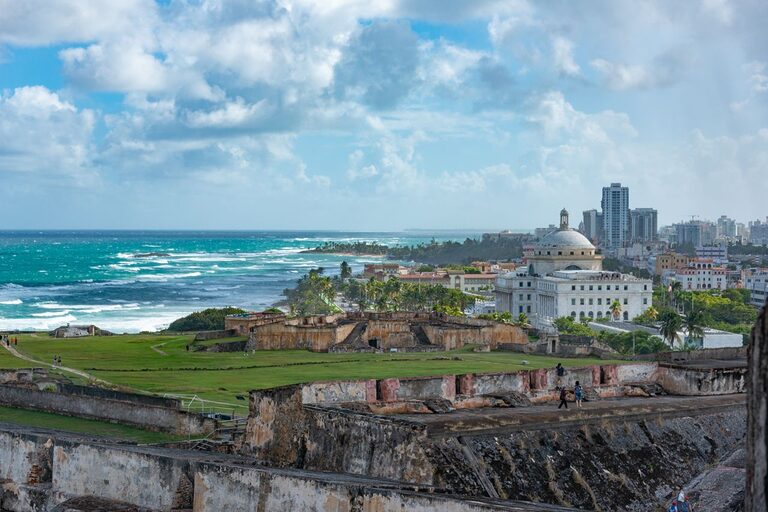
So, you are travelling to Puerto Rico.
Excellent choice.
You are about to discover a beautiful Caribbean island filled with golden beaches, colourful colonial streets, lush tropical rainforests, dramatic mountains, historic forts, delicious food and enough sunshine to make you seriously reconsider your relationship with winter.
And then there is the music.
Puerto Rico has a wonderful way of making ordinary moments feel like a celebration.
You might arrive expecting a relaxing Caribbean holiday filled with beaches, palm trees and refreshing tropical drinks.
And you will certainly find those.
But you will also discover centuries of fascinating history, lively neighbourhoods, spectacular waterfalls, charming coastal towns and a culture that proudly blends Spanish, African and Indigenous Taíno influences.
Puerto Rico is also the birthplace of some of the world’s most recognisable reggaeton and salsa music.
So do not be surprised if your peaceful evening stroll suddenly comes with an unexpected soundtrack.
And possibly some dancing.
Even if you have absolutely no intention of participating.
This is an island where you can explore a 16th-century fortress in the morning, hike through a tropical rainforest in the afternoon and finish your day watching the sunset over the Caribbean Sea.
All while enjoying food so delicious that your carefully planned sightseeing schedule may occasionally become a secondary priority.
However, Puerto Rico has its own weather patterns, transport challenges, cultural customs and practical considerations that are worth understanding before you arrive.
Because nothing interrupts a perfectly organised Caribbean adventure quite like discovering that your rental car is on the wrong side of the island.
Or that the beautiful beach you planned to visit requires a ferry ticket you should have booked three weeks ago.
To help you travel smarter, save money and enjoy your Puerto Rican adventure with fewer unnecessary surprises, here are 10 useful travel hacks for visiting Puerto Rico.
1. Choose Your Travel Dates Carefully
🌤️ Puerto Rico enjoys a tropical climate.
Which sounds wonderful.
And generally, it is.
Warm temperatures, beautiful beaches and plenty of sunshine make the island an attractive destination throughout the year.
However, tropical weather has a habit of making its own arrangements.
Sometimes without consulting your holiday itinerary.
Puerto Rico generally experiences its drier season from December to April.
This is a popular time for visitors, particularly those hoping to escape colder weather elsewhere.
Temperatures are usually comfortable for sightseeing, beach activities and outdoor adventures.
Unfortunately, excellent weather also attracts other travellers.
Lots of them.
Which means popular hotels, tours and attractions can become more expensive and crowded.
The wetter months generally extend from May to November.
Rain showers are more frequent, although they often arrive in short bursts rather than continuing all day.
Then there is hurricane season.
The Atlantic hurricane season officially runs from 1 June to 30 November, with activity typically peaking between August and October.
This does not mean a hurricane will appear during your holiday.
But it does mean that tropical storms and weather disruptions are important considerations.
💡 Travel Hack: For a balance between pleasant weather and potentially lower prices, consider travelling in late April, May or early December.
If visiting during hurricane season, monitor official weather forecasts and consider travel insurance that specifically covers relevant weather disruptions.
Choose flexible accommodation and transport bookings where possible.
Pack lightweight clothing, sunscreen, insect repellent and a compact waterproof jacket.
And remember that a tropical weather forecast showing rain does not necessarily mean your entire day is ruined.
Sometimes the rain disappears after 20 minutes.
Sometimes it stays longer.
The important thing is having a backup plan.
Preferably one involving excellent Puerto Rican food.
2. Understand Puerto Rico’s Connection To The United States
🛂 Here is something that occasionally surprises first-time visitors.
Puerto Rico is not an independent country.
It is a self-governing United States territory.
And while the island has its own distinctive culture, history and identity, its political status affects several practical aspects of travelling there.
For example, Puerto Rico uses the United States dollar (USD).
So there is no separate Puerto Rican currency to exchange.
Which is convenient.
Especially if your previous holiday involved trying to calculate exchange rates while a queue of increasingly impatient customers formed behind you.
However, entry requirements are particularly important.
For United States citizens travelling directly between the US mainland and Puerto Rico, the journey is generally treated as domestic travel.
A passport is not normally required for this journey, although travellers aged 18 and over need acceptable identification for airport security.
For international visitors, the situation is different.
Puerto Rico follows United States immigration rules.
This means British travellers and visitors from other countries must meet the applicable US entry requirements.
Depending on nationality and individual circumstances, this may involve obtaining an ESTA authorisation under the Visa Waiver Program or applying for a US visa.
💡 Travel Hack: Check your entry requirements well before booking your trip.
If you are a British citizen, confirm whether you qualify for the US Visa Waiver Program and whether you need ESTA authorisation.
Do not assume that travelling to a Caribbean island means you can enter under the same rules as neighbouring Caribbean countries.
Also remember that Puerto Rico uses US dollars, standard US-style electrical plugs and predominantly 120-volt electricity.
Bring a suitable plug adaptor if travelling from the UK or another country with different sockets.
And check that your electrical devices support the local voltage.
Your hair straighteners may be very important to your holiday photographs.
But they are probably not worth an electrical incident.
3. Do Not Assume You Can Explore The Entire Island Without A Car
🚗 Puerto Rico may look relatively compact on a map.
And compared with many travel destinations, it certainly is.
However, this does not mean getting around is always straightforward.
San Juan, the capital, has several convenient transport options.
You can use taxis, ride-hailing services and public transport in certain areas.
Uber operates around San Juan and some surrounding locations, although availability becomes less reliable in more remote parts of the island.
Old San Juan is particularly enjoyable to explore on foot.
Its colourful streets, historic buildings and charming plazas make walking one of the best ways to experience the area.
But outside the main metropolitan region?
Things become a little more complicated.
Puerto Rico does not have an island-wide passenger railway network.
Public transport connections between towns can be limited.
And many of the island’s most beautiful beaches, waterfalls and mountain attractions are difficult to reach without private transport.
Which means that relying entirely on public transport may require considerable patience.
And possibly a complete restructuring of your holiday plans.
💡 Travel Hack: If you are staying mainly in San Juan, consider using Uber, taxis and walking instead of hiring a car for your entire visit.
Parking in Old San Juan can be challenging and expensive.
However, if you want to explore El Yunque National Forest, coastal towns, mountain villages and less accessible beaches, hiring a car is often the most practical option.
Remember that vehicles drive on the right-hand side of the road.
Check rental insurance, toll arrangements, parking costs and driving licence requirements before collecting your vehicle.
Download offline maps because mobile reception can become unreliable in mountainous areas.
And allow extra travel time when driving through the island’s interior.
Some roads are narrow, winding and steep.
Beautiful?
Absolutely.
Ideal for somebody who gets carsick after three consecutive bends?
Perhaps not.
4. Explore Beyond San Juan
🏝️ San Juan is wonderful.
There is no denying it.
The capital offers historic architecture, colourful streets, beautiful beaches, excellent restaurants and lively nightlife.
Old San Juan is especially memorable.
With its pastel-coloured colonial buildings, cobbled streets and impressive Spanish fortifications, it feels like somewhere you could happily spend several days.
And probably fill your phone with approximately 800 photographs.
However, Puerto Rico has much more to offer beyond the capital.
Head east and you will discover El Yunque National Forest, famous for its tropical scenery, hiking trails and waterfalls.
Travel west towards Rincón and you will find a relaxed coastal atmosphere, beautiful sunsets and popular surfing beaches.
Visit Ponce in the south to experience distinctive architecture, museums and a different side of Puerto Rican urban life.
Explore Cabo Rojo for dramatic coastal landscapes, salt flats and beautiful beaches.
Or venture into the island’s mountainous interior, where small towns, coffee-growing regions and scenic roads reveal a quieter side of Puerto Rico.
Then there are the offshore islands.
Vieques and Culebra are famous for their beaches, clear waters and natural beauty.
Culebra’s Flamenco Beach is particularly well known.
And for good reason.
Its beautiful sand and turquoise water look almost suspiciously perfect.
As though somebody adjusted the colours before allowing the public to see it.
💡 Travel Hack: Divide your itinerary into geographical areas rather than travelling back and forth across the island.
For example, spend a few days exploring San Juan before hiring a car for the eastern coast, rainforest or western beaches.
If visiting Vieques or Culebra, consider staying overnight rather than attempting to squeeze everything into a rushed day trip.
Allow enough time to enjoy each destination.
Puerto Rico rewards travellers who slow down.
You do not need to visit every beach, waterfall and historic building in a single afternoon.
This is a holiday.
Not an international sightseeing competition.
5. Book Ferries And Popular Experiences In Advance
⛴️ Puerto Rico has some spectacular attractions.
Unfortunately, other travellers have discovered them too.
And certain experiences require more planning than simply arriving with a camera and an enthusiastic attitude.
One of the most important examples is travelling to Vieques and Culebra.
Passenger ferries operate from Ceiba on Puerto Rico’s eastern coast.
These services provide an affordable way to reach the islands.
However, tickets can sell out, particularly during weekends, public holidays and busy travel periods.
Ferry schedules may also change because of weather or operational conditions.
And Ceiba is not particularly close to central San Juan.
So you need to consider how you will reach the terminal.
Another experience worth planning is Puerto Rico’s famous bioluminescent bays.
These remarkable locations contain microscopic organisms that can produce a glowing effect when the water is disturbed.
Puerto Rico has three well-known bioluminescent bays:
Mosquito Bay in Vieques
Laguna Grande in Fajardo
La Parguera in Lajas
Mosquito Bay is particularly famous for its impressive bioluminescence.
On a suitable night, the water can appear to sparkle with an almost magical blue glow.
It is an extraordinary natural phenomenon.
Although, unlike the photographs you may have seen online, the experience is not guaranteed to look like somebody poured a thousand glowing fairy lights into the sea.
Brightness depends on environmental conditions.
💡 Travel Hack: Book ferry tickets and popular tours as early as practical, especially during peak season.
For bioluminescent bay experiences, consider visiting around a new moon when darker skies can make the glow easier to appreciate.
Check whether your chosen tour operates under current weather and environmental conditions.
Follow all conservation rules and avoid using flash photography where prohibited.
For Vieques and Culebra, arrange local transport before arriving.
Do not assume taxis or rental vehicles will always be available at the last minute.
And remember that ferry tickets, tour reservations and transport arrangements are three separate things.
Booking one does not magically organise the others.
Unfortunately.
6. Eat Like A Local Instead Of Relying On Tourist Restaurants
🍽️ Puerto Rican food deserves serious attention.
Very serious attention.
Because this is an island where a simple lunch can become one of the most memorable parts of your holiday.
Puerto Rican cuisine reflects Spanish, African and Indigenous Taíno influences.
The result is a delicious combination of comforting dishes, bold flavours and traditional cooking methods.
One dish you should definitely try is mofongo.
Made from mashed fried green plantains, often mixed with garlic, oil or pork cracklings, mofongo is commonly served with meat, seafood or vegetables.
It is filling.
It is delicious.
And it may convince you that plantains have been seriously underappreciated in your previous culinary experiences.
Other popular foods include:
Arroz con gandules: Rice cooked with pigeon peas and seasonings, often enjoyed during celebrations.
Lechón asado: Slow-roasted pork, especially famous in the mountain town of Guavate.
Alcapurrias: Fried fritters typically made with green banana or root vegetable dough and savoury fillings.
Bacalaitos: Crispy salted cod fritters, commonly found at roadside food stalls.
Pasteles: Traditional parcels made with seasoned root vegetable dough and fillings, wrapped in banana leaves.
Tembleque: A creamy coconut dessert that is particularly popular during the festive season.
And then there are the drinks.
Puerto Rico is closely associated with the piña colada, although different establishments have competing claims about its origins.
Either way, enjoying a refreshing tropical drink in the Caribbean is hardly the worst way to spend an afternoon.
💡 Travel Hack: Look for local fondas, bakeries, roadside food stalls and family-run restaurants.
These establishments can offer excellent food at more affordable prices than restaurants in heavily tourist-oriented areas.
Ask about the plato del día, or daily special.
It can be a great way to enjoy a satisfying local meal without spending too much.
For a memorable food experience, consider visiting the famous pork restaurants along Guavate’s Ruta del Lechón.
Bring some cash because smaller establishments may not always accept cards.
And if you have dietary restrictions, ask about ingredients before ordering.
Puerto Rican cooking frequently uses pork, seafood and other ingredients that may not be immediately obvious.
Finally, do not underestimate portion sizes.
You may order what looks like a perfectly reasonable lunch.
And discover that you have accidentally arranged dinner as well.
7. Learn A Little Spanish And Embrace The Local Culture
🗣️ Spanish is the dominant everyday language in Puerto Rico.
English is also an official language and is commonly encountered in tourist areas, hotels and many businesses.
However, English proficiency varies across the island.
In San Juan, you may find it relatively easy to communicate in English.
Travel into smaller towns or rural areas and Spanish becomes considerably more useful.
Fortunately, you do not need to become fluent before visiting.
A few basic phrases can make everyday interactions easier and show appreciation for the local culture.
Here are some useful expressions:
Spanish phrase
Meaning
Hola
Hello
Buenos días
Good morning
Por favor
Please
Gracias
Thank you
Disculpe
Excuse me
¿Cuánto cuesta?
How much does it cost?
¿Dónde está el baño?
Where is the toilet?
La cuenta, por favor
The bill, please
No entiendo
I don’t understand
¡Buen provecho!
Enjoy your meal
Puerto Rican Spanish also has distinctive local expressions.
You may hear the word boricua, which is a proud term associated with Puerto Rican identity.
It comes from Borikén or Borinquen, the Indigenous Taíno name for the island.
You may also hear wepa, an enthusiastic expression often used to celebrate excitement or happiness.
And believe me.
Puerto Ricans know how to celebrate.
Music, dancing, festivals and family gatherings are important parts of the island’s cultural life.
💡 Travel Hack: Learn a few basic Spanish phrases and download an offline Spanish translation pack before travelling.
Start conversations politely.
A simple buenos días or gracias can make a positive impression.
Be patient if communication takes a little longer than expected.
And remember that Puerto Rico has its own strong cultural identity.
Although it is a US territory, it is not simply a tropical version of the mainland United States.
Its history, traditions, music and everyday customs deserve to be appreciated on their own terms.
You do not need to master Puerto Rican slang before arriving.
Just be respectful, curious and willing to learn.
And if somebody invites you to dance salsa?
You are welcome to try.
Even if your feet have never previously agreed to cooperate with Latin music.
8. Be Smart About Beach Safety And Tropical Weather
🌊 Puerto Rico’s beaches are beautiful.
Golden sand.
Turquoise water.
Palm trees.
And the kind of scenery that makes checking work emails feel like a deeply unreasonable activity.
However, beautiful beaches are not automatically safe beaches.
Ocean conditions can vary significantly depending on the coastline, season and weather.
Some beaches experience strong currents, powerful waves and dangerous rip currents.
This is particularly important along exposed northern beaches, where Atlantic swells can create hazardous swimming conditions.
A beach may look calm from a distance.
But appearances can be misleading.
And the ocean is not particularly concerned about how confident you feel after watching three swimming tutorials online.
Another consideration is the tropical sun.
Even on cloudy days, ultraviolet radiation can be strong.
Mosquitoes are also common in tropical environments, particularly after rainfall and around standing water.
They can transmit illnesses such as dengue.
💡 Travel Hack: Before swimming, check local beach warnings, weather conditions and lifeguard guidance.
Choose beaches with lifeguards when possible.
Avoid entering the water when dangerous surf or rip current warnings are in effect.
If caught in a rip current, stay calm, avoid fighting directly against it and swim parallel to the shore when able.
Use sunscreen, wear protective clothing and drink plenty of water.
Apply an effective insect repellent, especially during early morning and evening activities.
If hiking through rainforests or visiting waterfalls, check conditions before setting out.
Heavy rain can cause sudden rises in water levels and dangerous flash flooding.
And never assume that a waterfall is safe simply because it looks beautiful in somebody else’s holiday photograph.
That photograph does not tell you what happened five minutes later.
9. Prepare For Occasional Power Cuts And Connectivity Problems
📱 Puerto Rico offers many of the conveniences travellers expect from a modern destination.
Hotels.
Shopping centres.
Restaurants.
Mobile networks.
Internet access.
And plenty of opportunities to upload photographs of your breakfast before you have actually finished eating it.
However, there is one practical consideration worth remembering.
Puerto Rico’s electricity infrastructure has experienced reliability challenges, including power outages.
Some interruptions may be brief.
Others can last considerably longer, particularly during severe weather or infrastructure problems.
Mobile coverage is generally good in major urban areas, but reception can become unreliable in remote mountain regions, forests and certain coastal locations.
Which can be inconvenient.
Especially when your navigation app suddenly decides that your exact location is a matter of personal interpretation.
💡 Travel Hack: Carry a fully charged power bank and keep essential devices charged whenever practical.
Download offline maps before travelling to remote areas.
Save copies of accommodation reservations, transport bookings and important travel documents where you can access them without an internet connection.
If you need reliable connectivity for work, check whether your accommodation has backup power and suitable internet facilities.
International visitors should also check mobile roaming charges before arriving.
Some US mobile plans include Puerto Rico, but coverage and roaming arrangements depend on the provider.
A travel eSIM or local mobile plan may be useful, depending on your device and existing contract.
And if you are planning a rainforest hike, do not rely entirely on your phone.
Carry enough water, know your route and let somebody know where you are going.
Your phone may be extremely clever.
But it cannot manufacture a mobile signal in the middle of a mountain.
10. Budget Carefully And Avoid Common Tourist Expenses
💰 Puerto Rico can accommodate different travel styles.
You can enjoy luxury beachfront resorts, private excursions and expensive restaurants.
Or explore beautiful beaches, historic neighbourhoods and local food spots without spending a fortune.
However, one mistake visitors sometimes make is assuming that every Caribbean destination is automatically inexpensive.
Puerto Rico uses US dollars and certain travel expenses can be comparable to those in mainland US tourist destinations.
Accommodation in popular areas can be costly during peak season.
Rental cars, parking, guided tours and restaurant bills can also add up.
And if you are travelling with a family?
Those seemingly small expenses have an impressive ability to multiply.
Another consideration is that advertised prices may not include every additional charge.
Hotels may add resort fees or other mandatory charges.
Restaurants may add applicable sales taxes and service charges.
And tipping is customary in many hospitality settings.
💡 Travel Hack: Compare the total cost of accommodation rather than focusing only on the advertised nightly rate.
Check for taxes, resort fees, parking charges and other additional costs before confirming your booking.
If hiring a car, factor in insurance, fuel, tolls and parking.
Consider staying outside the most expensive tourist districts if convenient transport is available.
Look for free or inexpensive activities such as exploring Old San Juan’s streets, enjoying public beaches and discovering local town squares.
Some museums and historic attractions offer reduced admission or free-entry periods, so check their official websites.
For meals, mix restaurant visits with bakeries, food kiosks and local daily specials.
Keep a small amount of cash for smaller purchases and unexpected situations.
And when paying by card, check whether your bank charges foreign transaction fees.
Finally, leave a little flexibility in your budget.
Because you may arrive in Puerto Rico convinced that you only need a few souvenirs.
Then discover local coffee, handmade crafts, beautiful artwork and approximately 14 things you suddenly cannot imagine returning home without.
Your suitcase may survive.
Your budget might need encouragement.
🌺 Final Puerto Rico Thoughts
Puerto Rico is one of those destinations that offers considerably more than its beautiful beaches.
The history is fascinating.
The landscapes are spectacular.
The food is delicious.
The music is infectious.
And the island’s cultural identity gives every visit a distinctive character.
But travelling well is not simply about knowing which attractions to visit.
It is also about understanding how the destination works.
Choose your travel dates carefully.
Check your entry requirements.
Plan your transport.
Book popular experiences early.
Explore beyond San Juan.
Try the local food.
Learn a little Spanish.
Respect the environment.
And always pay attention to beach and weather conditions.
Most importantly, leave room for unexpected discoveries.
You might begin your morning wandering through the colourful streets of Old San Juan and end it watching the sunset from a quiet coastal village, you might visit El Yunque expecting a pleasant forest walk and discover scenery that makes you forget how many stairs you have climbed.
You might order mofongo simply because somebody recommended it and spend the rest of your holiday wondering why you had never tried it before.
Or you might find yourself listening to live salsa music, surrounded by smiling strangers, wondering how an ordinary evening became one of your favourite travel memories.
That is part of Puerto Rico’s magic.
It offers history, adventure, relaxation and culture in wonderfully generous quantities.
And while careful planning will help you avoid unnecessary expenses and travel complications, the best experiences are not always the ones you schedule.
Sometimes they are the moments you discover along the way.
So pack your sunscreen.
Bring comfortable shoes.
Practise your Spanish.
Keep your itinerary flexible.
And prepare to discover why Puerto Rico is affectionately known as La Isla del Encanto.
The Island of Enchantment.
A name that feels entirely appropriate.
Because once you have experienced its beaches, music, food and remarkable landscapes, you may find yourself facing one final travel problem.
Working out when you can return.
¡Buen viaje! 🇵🇷