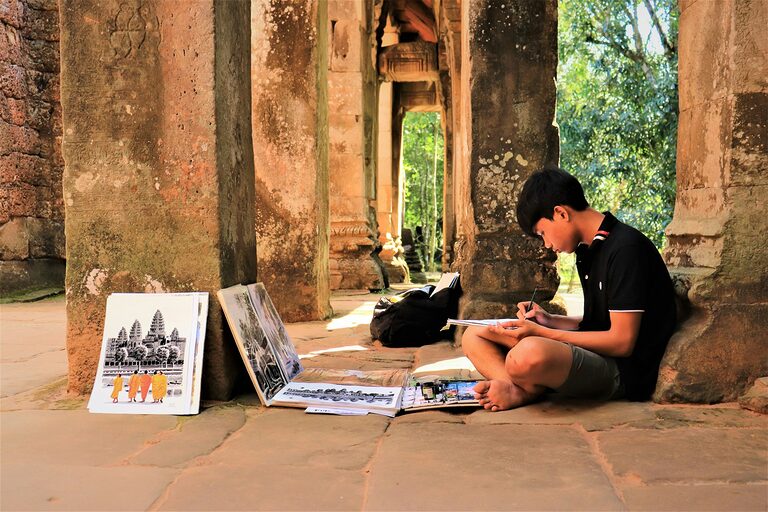
So, you are travelling to Cambodia.
Excellent choice.
You are about to discover ancient temples, tropical islands, bustling markets, peaceful countryside, lively cities, incredible food and one of the most extraordinary archaeological sites on Earth.
Cambodia is welcoming, fascinating and surprisingly easy to fall in love with.
But like every country, it has its own customs, cultural expectations and practical travel rules.
And while most Cambodian people will understand that visitors occasionally make mistakes, there are certain things you should probably avoid.
Some are about respect.
Some are about safety.
And some are about preventing yourself from becoming that tourist.
You know the one.
The person climbing somewhere clearly marked “Do Not Climb” because apparently the perfect holiday photograph is worth challenging several centuries of heritage conservation.
To help you travel respectfully, safely and with considerably fewer awkward moments, here are 10 things you should not do as a tourist in Cambodia.
1. Don’t Dress Disrespectfully At Temples
👕 Cambodia may be hot.
Very hot.
The kind of hot that makes wearing anything more substantial than a swimming costume feel unnecessarily ambitious.
But temples are not beaches.
Religious sites such as Angkor Wat remain sacred places and visitors are expected to dress appropriately. Official guidance for Angkor asks visitors to wear respectful clothing and UK travel advice notes that bare shoulders and shorts or skirts above the knee can result in refused entry to religious sites.
This is not the moment for your smallest pair of shorts.
💡 Better Idea: Wear lightweight clothing that covers your shoulders and knees when visiting temples and other religious sites.
Choose breathable fabrics so you can remain respectful without slowly transforming into a human radiator.
Check the specific rules before visiting individual sites too.
Cambodia’s temples deserve respect.
Your knees can survive being covered for a few hours.
2. Don’t Climb Or Touch Ancient Temples Where You Shouldn’t
🏛️ Angkor’s temples have survived for centuries.
Wars.
Weather.
Jungle.
Time.
They do not need to survive your attempt at obtaining a dramatic profile picture.
The official Angkor Visitor Code asks visitors not to touch or climb on monuments and to follow signs around the archaeological park.
Some areas may look extremely tempting to explore.
That does not mean you should.
💡 Better Idea: Stay on designated routes, respect barriers and follow instructions from staff.
Avoid touching carvings unnecessarily and never climb onto structures simply because somebody else is doing it.
If there is a sign telling you not to enter somewhere, consider this useful information rather than the beginning of a challenge.
Your photograph will still look excellent from the permitted side.
3. Don’t Treat Monks Like Tourist Attractions
🙏 Buddhist monks are an important part of Cambodian religious and cultural life.
They are not decorative accessories for your holiday photographs.
If you would like to photograph a monk, ask permission first. UK travel guidance specifically advises visitors to ask before photographing people, particularly monks and other religious figures.
Also remember that religious etiquette can affect physical interactions, particularly between monks and women.
💡 Better Idea: Be respectful, keep an appropriate distance and observe how local people behave.
If you are unsure whether something is appropriate, ask.
And if you want a photograph of somebody, requesting permission takes approximately three seconds.
This applies everywhere.
Cambodia included.
Being on holiday does not transform other human beings into scenery.
4. Don’t Wander Off Established Routes In Rural Areas
🥾 Cambodia has beautiful countryside.
Rice fields.
Forests.
Remote temples.
Quiet villages.
Wonderful places for exploration.
But this is one situation where spontaneous wandering can become genuinely dangerous.
Cambodia remains affected by landmines and unexploded ordnance, particularly in some rural and border areas. UK travel guidance warns travellers not to stray from main routes in rural areas, including around some temple complexes, and not to pick up unidentified metal objects.
This is not something to take casually.
💡 Better Idea: Stick to established roads, marked paths and recognised tourist routes in affected areas.
If you want to explore somewhere remote, use a knowledgeable local guide and follow local advice.
Do not wander into fields, forests or abandoned areas simply because they look interesting.
And absolutely do not pick up mysterious pieces of metal.
Some souvenirs belong exactly where you found them.
5. Don’t Flash Your Phone And Valuables Around Carelessly
📱 Your smartphone is extremely useful in Cambodia.
Maps.
Translation.
Transport.
Photography.
Restaurant reviews.
Checking whether you really ordered what you think you ordered.
Excellent device.
But that does not mean it needs to spend the entire holiday dramatically extended towards the road.
Petty theft and bag snatching can occur, particularly in busy areas and from passing vehicles.
💡 Better Idea: Use your phone sensibly and keep valuables secure.
When travelling by tuk-tuk, keep bags away from the open side where possible and avoid loosely holding your phone near traffic.
Carry only the valuables you actually need during the day.
You do not need to become suspicious of everybody around you.
Just avoid making your belongings unnecessarily easy to grab.
Your phone should return home with you.
It has photographs to deliver.
6. Don’t Give Money To Children Around Tourist Attractions
💵 You may encounter children selling souvenirs, postcards or other items around popular tourist areas.
Your immediate instinct may be to help.
Completely understandable.
But giving money directly to children or buying from child vendors can have unintended consequences.
At Angkor, the official visitor guidance specifically asks tourists not to give money to children.
Responsible tourism sometimes requires thinking beyond the immediate interaction.
💡 Better Idea: If you want to support Cambodian communities, consider reputable organisations, social enterprises and community-based projects that focus on education, families and long-term development.
Research organisations before donating.
Helping responsibly may require slightly more effort than handing over a dollar.
But the objective is not simply to feel helpful.
It is to actually help.
7. Don’t Lose Your Temper When Things Move Slowly
🚌 Your bus may leave later than expected.
Your food might take longer than anticipated.
Your tuk-tuk driver may misunderstand the location.
The ferry timetable may occasionally appear to have entered a philosophical relationship with the concept of time.
Welcome to travelling.
Getting visibly angry rarely improves the situation.
In Cambodia, as throughout much of Southeast Asia, maintaining politeness and composure is generally a much more effective way to resolve problems.
💡 Better Idea: Stay calm, smile and explain the problem clearly.
Build some flexibility into your itinerary so small delays do not immediately create a chain reaction of travel disasters.
If something genuinely needs fixing, be firm but polite.
You are considerably more likely to solve a problem through patience than by performing an internationally travelling version of:
“I would like to speak to the manager.”
8. Don’t Assume Every Price Is Negotiable
🛍️ Bargaining can be part of shopping at some Cambodian markets.
It can also be fun.
You ask a price.
The seller gives you a price.
You make an offer.
They laugh.
You laugh.
Diplomatic negotiations begin.
But not everything in Cambodia is negotiable.
Restaurants, supermarkets, convenience shops, ticket offices and businesses with clearly displayed fixed prices generally do not require your newly developed bargaining skills.
💡 Better Idea: Bargain only where it is appropriate and keep negotiations friendly.
If you are negotiating at a market, remember the amount you are debating may be relatively small compared with your overall holiday budget.
There is a point where successfully reducing the price by another 50 pence stops being a glorious financial victory.
Especially when you immediately spend £4 on an iced coffee.
Perspective is useful.
9. Don’t Ignore Local History
📚 Cambodia is beautiful.
But its modern history also contains extraordinary suffering.
The Khmer Rouge period remains within living memory and its effects continue to matter deeply.
Sites connected with this history can be important places for visitors to learn and reflect.
They are not ordinary tourist attractions.
This means behaving appropriately when visiting memorials, museums and sites associated with tragedy.
💡 Better Idea: Learn some Cambodian history before and during your journey.
Visit historical sites respectfully.
Read the information.
Listen to guides.
Avoid inappropriate photographs or jokes.
And be sensitive when discussing Cambodia’s past with local people.
Understanding the history will give you a much deeper appreciation of the country you are travelling through.
Cambodia is more than its temples and beaches.
Knowing its story matters.
10. Don’t Spend Your Entire Trip At Angkor Wat
🌴 Angkor Wat is extraordinary.
Absolutely visit it.
Wake up ridiculously early.
Watch the sunrise.
Explore the temples.
Take approximately 700 photographs.
Become temporarily convinced you are an archaeological photographer.
Wonderful.
But then keep travelling.
Cambodia has considerably more to offer.
There is Phnom Penh.
Battambang.
Kampot.
Kep.
Tropical islands.
The Mekong.
Countryside.
Markets.
Food.
Villages.
Mountains.
And countless experiences that have absolutely nothing to do with waking up at 4:30 in the morning to photograph a temple.
💡 Better Idea: Give yourself enough time to experience different sides of Cambodia.
Explore a city.
Spend time in the countryside.
Try Cambodian food somewhere without an enormous tourist menu outside.
Visit the coast.
Take a boat journey.
Sit beside the river with absolutely nothing scheduled.
Angkor may be Cambodia’s most famous attraction.
It is not Cambodia’s entire personality.
✨ Final Cambodia Thoughts
Cambodia is an incredibly rewarding country to explore.
Ancient temples.
Tropical landscapes.
Bustling cities.
Quiet countryside.
Beautiful islands.
Fascinating history.
Fantastic food.
And tuk-tuks.
Many, many tuk-tuks.
Travelling responsibly in Cambodia does not require memorising an enormous book of rules.
Most of it comes down to something considerably simpler.
Respect religious sites, respect local people, respect Cambodian history.
Respect the environment.
And respect signs telling you not to climb ancient temples.
They really do mean it.
Dress appropriately when visiting sacred places, keep your valuables secure and stay on established routes when exploring rural areas where unexploded ordnance may remain a risk.
Bargain with a smile.
Ask before photographing people.
Support local communities responsibly.
And do not become so focused on seeing Angkor Wat that you forget there is an entire country waiting beyond it.
Most importantly, travel with curiosity rather than expectations.
Cambodia will occasionally surprise you.
Transport might take longer than planned.
The weather might completely rearrange your afternoon.
You might order something from a menu without being entirely certain what will arrive.
Excellent.
That is part of travelling.
Some of your favourite Cambodian memories may come from the moments you never planned.
The tiny restaurant.
The unexpected tuk-tuk journey.
The conversation with somebody you met along the way.
The town you originally intended to visit for one night and somehow stayed for three.
Travel respectfully, stay curious and give yourself enough time to experience Cambodia beyond the obvious attractions.
And please leave the ancient temples exactly where Cambodia has successfully kept them for centuries.
Your Instagram account will cope.